![The best gardens to visit this autumn?]()
by Mark Bailey | Oct 23, 2018 | GardenLife Magazine

The best gardens to visit this autumn?
Autumn, with its orange, red and ochre colour palette, is a sweet spot when it comes to gardens. Sandwiched between baking summer weather and winter’s short cold days, it is a beautiful season.
Many of the British Isles’ gardens, parks and stately homes look their most glorious in October and November. So, we’ve picked some of our favourite gardens around England, Scotland, Wales and Northern Ireland. Any of which is fit for a visit in the season of mellow fruitfulness.
You could go for a day out with family and friends, some garden inspiration, or to help children or pets burn off some energy. So, what are some of the best gardens to visit this autumn?
Visiting Sheffield Park and Garden in autumn

You’d be forgiven for thinking this spectacular park, complete with four ornamental lakes and dense woodland, is in Sheffield. It is however in East Sussex.
Once a WW2 camp and a deer park, it’s now a terrifically Instagram-friendly setting. Its reflections of autumnal trees in the lakes attract thousands of photo-hungry visitors every year. There are numerous glades, wooded areas, paths and tree varieties – ideal for gardeners and those who want a peaceful, rural stroll.
It’s also very family friendly (you can even arrive by the nearby steam train), and it’s open all year round. If you’re into photography, Sheffield Park is definitely one of the best gardens to visit this autumn.
Hillier Gardens are full of autumn colour

Another great autumn garden in Southern England is Hillier Gardens, in Hampshire, which really comes into its own in the autumn months. If you’re looking for inspiration, take a look at the valley of Japanese maples (‘Acer Valley’). The various plantings of shrubs and perennials are great examples of how to keep colour in your garden well into autumn and winter.
This is another child-friendly option, thanks to a butterfly park, bamboo wood chimes and an education centre. It’s open all year, and children under 5 can get in free. Dogs, on the other hand, are banned.
View further details of prices and opening times.
Castle Howard has a bit of everything

For those of a certain age, Castle Howard will be familiar from the 1980s TV series Brideshead Revisited (starring Jeremy Irons), which was filmed in its grounds. Scenes from the TV series Victoria and a Garfield film were also shot here.
The more active may know it for the Triathlon series held there each summer.
Near Leeds and York, its vast grounds house walled gardens, woodlands, lakes and even a temple and tree nursery. It’s open year-round, is dog-friendly and is one of the best gardens to visit this autumn.
Castle Howard is a full-scale commercial operation, so the events programme is packed. Autumn events include child-friendly Halloween bashes, followed by Twelve Days of Christmas events. Regular visits from Father Christmas start at the beginning of November too.
If you confine your visit to the garden centre, entry is free, otherwise, you need a ticket.
Hergest Croft Gardens, a Welsh autumnal treat

In the heart of the Welsh Marches, with views towards the Black Mountains, lie the Hergest gardens, home to the UK’s ‘national collection’ of maple and birch trees, among others.
The 70-odd acres of trees and shrubs are particularly attractive from October onwards. Dogs and picnics are allowed, and kids go free with adults (the common is perfect for running off some energy).
If you’re planning a visit, you’ll need to act quickly – it closes at the end of the October until March. But if buy a season ticket holder, you can visit all year.
For more information on these beautiful Herefordshire gardens visit the website.
The best gardens to visit in Scotland this autumn?

Further north, in the Scottish Borders, the Dawyck (pronounced “doyk”) gardens stay open until the end of November (before the northern chill sets in properly). They house some displays you’re unlikely to find elsewhere – a four-season moss and fungi reserve, towering trees from the sixteenth century alongside Japanese and American species in glorious orange colours, and fruits and conkers galore.
Autumn garden tours and Halloween themed walks punctuate the autumn events timetable. As part of the Royal Botanic Garden of Edinburgh (RBGE), it’s rather disapproving of leisure though – so it’s definitely not one of the best gardens to visit this autumn if you’re into dogs, throwing balls, playing games or jogging.
If you want a Botanic garden to visit in December, the Edinburgh Botanics will still be open, and there are various cafes where you can warm yourself up during your visit.
Mount Stewart in autumn, Northern Ireland

Over the Irish Sea now, to County Down, where the famous Mediterranean-style gardens apparently are based on an Italian villa landscape. Admittedly, autumn in Northern Ireland is hardly Italianate, but there’s plenty to see outside the summer months because it’s planted for all seasons.
As well as walled gardens, landscaping and lakes, Mount Stewart has its own squirrel trail, where you can spot the elusive red species.
There are also plenty of seasonal activities, like Halloween activities in late October and early November. It’s also something of a birdwatchers’ haven and it’s open pretty much year round, although the adjacent Stewart House isn’t.
For more information about prices, opening times and what to see have a look at the Mount Stewart website.
If you’re planning a trip to the UK for next year, check out our earlier guide to the best gardens to visit in the summer months.
![Shed and garden fence sprayer – electric, cordless or manual?]()
by Mark Bailey | Sep 19, 2018 | GardenLife Magazine

Colder months and cooler temperatures call for garden winter-proofing – not just plants and shrubs, but sheds, summer houses, garden rooms, decking and fences too.
In fact, if any timber garden building goes too long without paint or wood preservatives, damp and rot can creep in all too easily. Even the densest timber and highest-quality build structure can be affected.
GardenLife know painting and wood-treatment is not the most exciting of tasks, but it really is worth doing. It can extend the life of a summer house, garden shed, decking or fence by years. So, to help relieve some of that workload, we’re taking a look at some mechanical help, in the form of various types of garden fence sprayer.
Why use a garden fence sprayer?

Variously called “pressure sprayers”, “paint sprayers”, “spray guns” or “pump sprayers”, these labour saving devices are made by the likes of Ronseal, Cuprinol, Wagner and B&Q.
In a nutshell, using a shed and garden fence sprayer to apply preservative or paint is far quicker than a brush. You’re also more likely to get better, more even coverage. This in turn will protect the timber more effectively. Many garden fence sprayers have adjustable spray nozzles and speed controls, so you can control how much preservative or paint is used, and easily get into tight corners or small gaps.
You do need to be aware of the need to clean your shed and garden fence sprayer, as well as health and safety precautions, but we’ll guide you through those shortly.
Different power sources for garden fence sprayers
There are three distinct categories of shed and garden fence sprayer: corded, cordless and manual. So we’re going to look at the different types, with their pros and cons, and also mention some of the popular models on the market for each type. Of course, there are many other models available too – but the examples below (and their reviews) will give you a guide to what to look out for if you’re considering other models.
Mains-powered electrical garden fence sprayers
The advantages of electrical sprayers are obvious – as with anything from vacuum cleaners to radios, there’s no faffing about with replacing or recharging batteries, and they’re efficient in terms of power consumption.
Then again, there’s also an obvious disadvantage – namely, the cable. The fact it may not reach to the end of your garden, and the impossibility of finding an extension lead when you need one.
Wagner Electric Garden Shed & Fence Sprayer

At £69.99, this one is a little pricey but it’s versatile and gets mainly 5 star reviews. It has an adjustable spray jet so you can tailor it to the size of panelling you’re working with, and the amount of paint you want to use. The tank is housed separately and can stand on the ground or be carried around with a shoulder strap; its capacity is definitely on the smaller side though at 1.4l, so bear that in mind and be prepared for regular refills
Cordless garden fence sprayers
Cordless shed and garden fence sprayer are generally designed to be versatile and easily portable. They offer the speed and coverage of electric-powered models, without the issue of having a cable dragging round behind you.
But instead you have the battery issue – some are rechargeable and can be used anywhere, but charge times can be long and running times short. Others have traditional batteries, but then you have to keep on buying batteries.
Ronseal Precision Finish Fence Paint Sprayer

At £32 this ticks the boxes on versatility – there are different power and nozzle settings for control, speed and accuracy. The tank itself is a generous 5 litres, but the cord attaching the nozzle is quite short so it’s not idea for some garden or fence layouts.
Reviews are mixed – there are plenty of 5 star reviews from users saying how it saved them hours or days compared to using a brush, but other reviews complain of clogging.
As with all products that get mixed reviews, you want to apply some common sense to what you read. For example, the reviewer who complained about spray going everywhere on a very windy day should probably blame their own choice of spraying day rather than the product!
Manual shed and garden fence sprayers
Manual sprayers come in cheap, sturdy and versatile. But since they need to be pressurised by hand, they’re not great for anything larger than a few fence panels. As you’d expect, both Ronseal and Cuprinol both have popular models, but the following Spear & Jackson sprayer is difficult to beat.
Spear & Jackson Pressure Sprayer for Wood Stain

Cheap and (thanks to its pump mechanism) reliable, it would seem it’s hard to go wrong with this one – the 3 bar pressure level will even discharge a consistent spray for a prolonged period. There’s a 5l tank, easy to clean brass fittings, and it will spray water, weedkiller and chemicals with pH values between 5 and 9 (including water-based wood stain).
With an average of 4 stars from over two thousand reviews, £22.50 represents very good value for money.
Cuprinol pump and brush garden fence sprayer MPSB

It certainly looks peculiar but this Cuprinol fence sprayer has the novel idea of combining a manually charged sprayer and a brush to add finishing touches. The tank is smaller than some others on this list, and the tank and nozzle are all in the same housing so you have to carry everything around together, but reviews are mostly very positive (and also contain some useful tips about how to get the best results) and it’s only £28.
General tips
With all types of shed and garden fence sprayer, you’ll want to think about the following:
- whether they only work with specific types of preservative or paint (which may limit their use or lock you into expensive products)
- whether you’ll actually be able to carry them once you’ve filled them up with your treatment product
- how easy they’ll be to fill, refill and – crucially – clean
- does the choice of nozzles and length of hose suit you – if you have awkward spaces to reach, are there precision nozzles or extension tubes?
- if you have large expanses of timber to treat, how large is the tank and how fast is the coverage?
- always wear safety gear – goggles, a respirator, gloves and overalls
Finally, even where garden fence sprayers have adjustable nozzles, they can sometimes spray erratically. So, if there are any people, pets, garden structures, windows, plants, ponds or washing lines nearby, proceed with caution (or not at all!).
![Living willow structures – grow your own gazebo, arches and pergolas]()
by Mark Bailey | Aug 23, 2018 | GardenLife Magazine, How to guide
You’ll be amazed how simple it is to grow your own living willow structure

Cut a ‘whip’ off a willow tree, shove it in the ground at any angle and it will probably grow. Not only that, it will do so even in the swampiest of environments, reliably shooting up a couple of metres a year.
As a result, it’s possible to make gorgeous and practical living willow structures in your garden. Arches, gazebos, pergolas, dens, play areas and even so-called ‘fedges’ can all be constructed from as little as a willow twig. This is a really cost effective design option if you can’t quite afford a more substantial timber gazebo for your garden.
Here are some ideas and advice on creating your own living willow structures.
Preparations for living willow structures
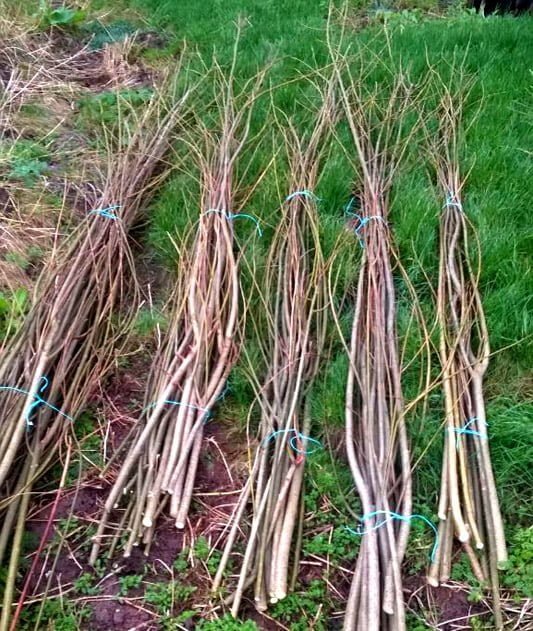
First of all, given there are more species of willow than you can count, you need to pick one. The Royal Horticultural Society (RHS) suggest, ‘Salix alba var. vitellina (golden willow), S. daphnoides, S. alba var. vitellina ‘Britzensis’, S. viminalis and S. purpurea’ as the best living willow varieties to use. More advice about using willow in your garden design can be found on the the RHS website.
Where you plant your willow also requires planning. Ideal growing conditions are moist and in full sunlight. Be aware that their roots spread out rapidly, so pick a spot at least 10m from any buildings or pipes you know of.
In terms of preparing a site for living willow structures, it’s relatively straightforward. All you need to do is mark out your design shape, with string or sand, then install the whips! All of this should ideally be done in winter or early spring, which is when willow whips are normally harvested.
If you’ve already bought willow whips, store the thick ends in water to prevent them from drying out and prune off the end before planting. If you do this don’t allow the water to freeze in winter.
Planting living willow structures

Ideally, the thick end of the whip should be pushed in 20-30cm underground. The drier the ground or longer the rod, the deeper it will need to grow. But given willow’s extraordinary propensity to grow, you may well end up with a flourishing structure however you plant it!
Adding some compost to the soil when planting won’t go amiss. And willow plants actually enrich the surrounding soil themselves, allowing other nearby plants to flourish as long as the roots of the different plants don’t interfere with each other too much. You may also want to put heavy weedsheet around the base of the structure too – this can stop unwanted shoots growing where they aren’t wanted.
Different designs for living willow structures
1. A living willow pergola or arch

Using the longest willow whips you can get a hold of, plant a row on either side of a wooden arch or pergola, spaced 10-15cm apart. Let them grow straight up, tying them together at the top. It’ll look sparse at first, but weaving new shorts through the structure will help it fill out (though don’t point them downwards as they’ll probably die). The end result will be a lovely natural-looking spot to seek shade, read a book in, or whatever other use you find for it.
2. A living willow fedge

A willow fedge is a cross between a hedge and a fence. It can be used as a more organic-looking alternative to a fence – much more interesting than a wall of brown timber. They’re a good way to divide and section off your garden, creating different rooms or zones.
To make one, plant a single row of long willow whips about 25cm apart, each leaning at a 45-degree angle facing alternating directions. This will allow you to weave a lattice-structured fence which can be cut to the desired height. A willow fedge is that simple.
3. A living willow wigwam or dome

Although more complex to erect, these make good kids’ play areas or garden picnic spots – though they’re not guaranteed waterproof. To make a living willow wigwam, plant long sturdy willow whips about 30cm apart in a large circle. Leaning in alternate diagonals, with the strongest whips either side of your doorway.
Then fill in the gaps with smaller willow whips, depending on how thick you want the walls to be. Then weave the ends together at the top to create a beautiful intertwining roof. Or, for an easier project, just bundle them together to make a tepee-style roof.
4. Maintenance and aftercare for living willow structures

Willow, being suited to wet swampy conditions, needs a fair amount of watering, especially immediately after planting. Aim to water living willow structures every day for the first week, switching to every other day the next fortnight after that before easing off slightly (though this does depend on the weather you’re having).
Although willow’s prolific growth rate makes it perfect for a variety of garden structures, the downside is that regular pruning is a necessary evil. This will help your living willow structures fill out and strengthen with regrowth, instead of just growing taller and taller.
That being said, the willow whips that are removed can be used to make more designs, so it’s a fruitful chore. You could also use the whips to make willow baskets or sculptures – there are lots of courses for this nowadays.
Aphids (greenfly) are partial to willow, and in late summer can infest the plant and produce sticky honeydew which wasps are attracted to. Deer and rabbits are also a foe, and they are susceptible to various fungal diseases, so keep an eye out for this.
Sourcing willow whips
Simply cutting stems from any willow tree (preferably from the species listed above, and preferably asking the owner before you do so) lets you create a willow structure free of charge. There are also easy kits available on the Willows Nursery website and MusgroveWillows.co.uk.
Other useful articles about living willow structures and fedges
With these links and advice you should have everything you need to create your very own living willow structures or willow fedge.
![The best city parks to explore in the UK?]()
by Mark Bailey | Jul 13, 2018 | GardenLife Magazine

The best city parks to explore in the UK
What are large, green, used regularly by 37 million people, and coming up to 200 years old? The answer is the UK’s city parks, of which there are around 27,000 up and down the country.
Once seen as a radical and revolutionary proposition, they’re now part and parcel of our towns and cities (and some would say the best part). And though austerity poses an existential threat to many city parks (because cash-strapped councils can’t afford to maintain them or are even selling them off), they’re as popular as ever.
So, to celebrate these unsung heroes spanning the country, we’ll tell you a bit about their history, suggest some of the best city parks to explore in the UK, and look at the inspiration you can take back to your own green space.
A little background to our city parks

There are several claimants for the title of the UK’s first urban park (or what we recognise as one today) but a leading contender is Derby Arboretum, which opened its gates in 1840.
This city park still has many of its original Victorian ornaments and structure, including magnificent wild boar sculptures, but has also been updated with playground and sports facilities. Thanks to Lottery funding, it is still in good nick and is very much the same park which Central Park in NYC was based on.
On the horticultural side, it’s home to scores of tree varieties, some of which you will be hard pressed to find anywhere else in the UK. For more information about this lovely city park, including opening hours, have a look at the InDerby.org website.
Finding inspiration and ideas in city parks
Another city park steeped in history is Nottingham’s Arboretum Park, widely thought to be the inspiration for Neverland in J.M. Barrie’s novel Peter Pan.
There’s plenty of heritage here, with some of the original Victorian garden designs and buildings (including an aviary, bandstand and a Chinese-style bell tower commemorating the Crimean War and Anglo-Chinese Opium War). And if you’re into trees, this is the place for you – this city park has over 200 species and varieties, and a nicely laid out tree trail highlighting interesting or rare trees.
And if you’re inspired by the bandstand, admittedly it may be hard to recreate a wrought-iron Victorian in your own back garden, but there are gazebo designs available that could replicate the shape and open sides. Opening times and other visiting details are available here.

Oxford University Parks are also packed full of history, but their popularity for student BBQs makes them thoroughly twenty-first century in atmosphere.
There’s a huge amount to do or watch in these city parks – a botanic garden and nursery where friendly staff are stationed to offer advice on all things green, exercise classes, a cricket pitch where the University team play, other sports pitches, organised walks and bird watching.
For opening times, FAQs or some inspiration from their ‘Plant of the Week’ pages have a look at their website. And if you find yourself irritated at the fact that the Parks’ croquet lawns are not open to the general public, you could always create your own croquet lawn at home, with help from Croquet Online or Jacques London.
The best city parks to explore in the north?

Glasgow Green is currently in its peak festival-hosting season, but for the rest of the year this city park is home to sprawling open lawns and monuments and structures of all varieties. The 50m Nelson column and the wonderful People’s Palace (a museum of Glasgow history and culture in a glasshouse) get the most attention, but there’s also a suspension bridge, weir, various water features and fountains (inspiration for your own garden?), a good café in the Winter Gardens, and a play village.
Best of all, it’s a brilliant place to people-watch – the whole of Glasgow life passes through this city park. Find out more on the council website.
Perhaps more difficult to recreate…

Another city park that’s right at the heart of city life is Edinburgh’s Princes Street Gardens. Better known for concerts, fireworks and views of Edinburgh Castle than for its trees and plants, the Gardens actually house a true horticultural gem: the (working) floral clock.

Designed with a different theme each year, it takes a couple of gardeners several weeks to lay out and involves up to 40,000 plants. Recreated the world over from Mexico to Switzerland, it forms the centrepiece of the Gardens and is a real treat to see in the flesh.
Other hidden gems worth exploring
The big city parks tend to get all the attention, but it’s worth seeking out so-called ‘pocket parks’ around the UK’s cities and towns.

For example, in the heart of London, nestled a stone’s throw from St Pauls Cathedral hides Postman’s Park. Built near the former Post Office headquarters and once popular with the postmen who worked there – hence the name – it’s a serene green bubble in the heart of the Big Smoke.
As well as providing a great place to escape the crowds if you’re in this part of London, it may provide some ideas for your own patch: a quiet bench and pergola or gazebo with ivy running up and the end of your garden could nicely recreate this garden’ soothing effect and be a real haven from the cares and stresses of life.

Another well-kept secret in the capital is the conservatory at the Barbican Centre. Although only open on Sundays, it houses a mammoth catalogue of over 2000 tropical plants, trees, and even fish. Should you fancy a visit, opening times are available here.
![Playhouse ideas – how to build a playhouse for your kids]()
by Mark Bailey | Jun 25, 2018 | GardenLife Magazine

Playhouse ideas – how to build a playhouse for your kids
It’s a defining moment for every parent – the day your son or daughter asks if you’ll build them a playhouse (or a treehouse, if you’re lucky enough to have a mature tree in your back garden).
For the DIY gods of this world, it’s a wonderful excuse to get creative, unleash the power tools, and re-create the playhouse of your childhood – or childhood dreams. Some people will simply have endless playhouse ideas and designs.
But for the DIY phobics among us, it’s a defining moment for all the wrong reasons. Your ability to keep coming up with excuses won’t last, and it could be several years before the requests to build a playhouse or garden den finally subside. At this point your child will no-doubt have built their own stupendous playhouse in Minecraft, and their playhouse ideas won’t be hindered by DIY experience (or lack thereof).
So where to start? If you have basic DIY skills where do you get your playhouse ideas and inspiration from?
The dengineers – perfect for playhouse ideas
The fourth series of the CBBC series The Dengineers is being filmed in April-August this year, so will be hitting a TV screen some time soon.
For those of you who don’t know The Dengineers, it’s like Grand Designs or DIY SOS for kids. Each episode sees a crack team of designers and builders bring to life the den-dreams of an 8-12 year old.
A typical episode could see the dengineers build a back-garden den in the shape of a rugby ball; or a miniature wooden Scottish castle with turrets and working drawbridge; or a music playhouse with a façade like the front of a guitar amp.
They come up with amazing playhouse ideas and build them from scratch, or use an existing space such as an attic, basement or existing garden building. Materials are affordable and often recycled, and it’s great feel-good TV unless you happen to bump into your own inspired children shortly after an episode.
Building a playhouse or treehouse for beginners
So, if the next series of The Dengineers does get your family yearning for their own wonder-den, what can you do?
1. Consider the little playhouse details

Watch a whole episode of The Dengineers and you’ll see it’s the details that turn a den into a wonder-den. In the music den episode, for instance, it’s the addition of dials and a giant audio jack and cable that turn an ugly orange-framed box into a cool amp-themed den. And on the inside, serious sound-proofing turns into a serious rehearsal room, and a wall decorated with old vinyl give it a studio feel.
2. Don’t overthink your playhouse ideas

On the other hand, too much detail and too much interior design or furniture can spoil the best den or playhouse ideas.
If you think about it, your children’s den may house a toys’ tea party one day, and be a spy den the next. A pink palace may be great for the former, but not for the latter. So The Dengineers may accessorise down to the last detail for the sake of impressive TV, but you may not want to for your own den or playhouse ideas.
3. Everlasting playhouse perfection, or temporary fun?

Even the most digitally-fixated 21st-century kids can get caught up in the old-fashioned joys of building a playhouse. Not a DIY masterpiece with turrets or drawbridge, but a temporary lean-to made of old branches, wooden pallets, old tent poles, ripped sheets, and any other materials that can be borrowed or recycled. A living willow playhouse is also a great way to create a space for the kids without any DIY knowledge.

Almost as good are indoor dens involving tables, chairs, clothes horses and a variety of duvets, sheets and cushions, so the kids can take over a room for the day and pretend they’re invisible.
All you really need for a temporary playhouse, either outdoors or indoors, is an internal structure or framework, and things to drape over it. There are some good playhouse ideas on the Eden Project website.
4. If you decide to build a treehouse, do it properly
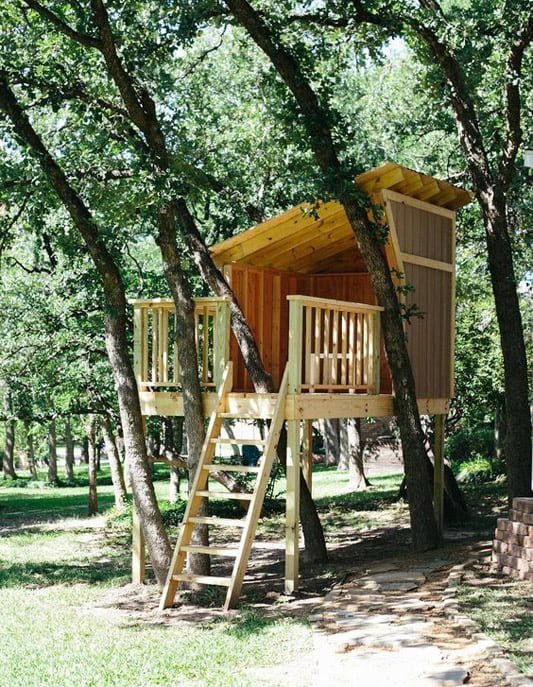
In books, memory and the imagination, treehouses are improvised affairs that materialise slowly as materials become available.
In most cases, that’s nonsense. Reach a bit further into your memories of those improvised treehouses and you may recall the broken arms and accidents involving damp wood or rusty nails that often came next.

If you do decide to build a treehouse, you need a plan, good materials and time on your hands (you may need planning permission too). There’s are good articles on the Independent and Dickies websites which will tell you all you need to know.
5. Take the lazy playhouse path

Simpler than coming up with your own playhouse ideas from scratch is to buy one. GardenLife Log Cabins has a good range of timber garden playhouses to catch any child’s imagination.
Designs include a miniature Alpine chalet for those that loved the book Heidi (or ski holidays!), a playhouse on stilts, or a design that looks like a Christmas gingerbread house brought to life, complete with tiny chimney, front ‘garden’ and porch.
All these timber houses are easy to assemble and built from sturdy Nordic timber and high-quality fittings, so certainly no issues with rusty nails and rotting wood.
6. Think beyond the playhouse

Finally, if your children are older, it’s a good idea to build (or buy) a design that can evolve – playhouse for the first couple of years, then teenage games room or music studio later on.
A flexible, plain timber building (either traditional or contemporary) that is flexible in terms of space and usage can easily be redecorated or re-themed at intervals to reflect the kids’ changing tastes. For example, if you buy a simple but solid garden building such as Vivian 3.8 sqm or Klara 4.7 sqm and paint it pink inside and out in years 1-3, and then re-design it with different colours and furnishings thereafter.
Hopefully with these playhouse ideas you can make your perfect den, be it a short-term lean-to, a beautifully original handmade playhouse, or a hassle-free off the shelf number delivered to your door.