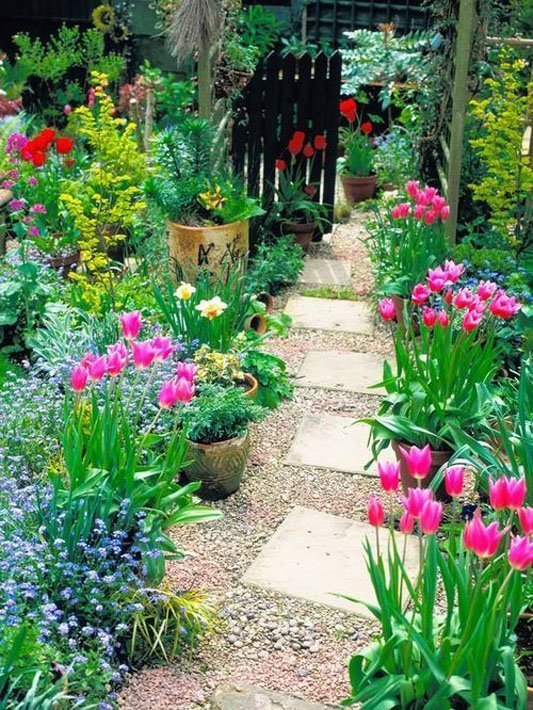
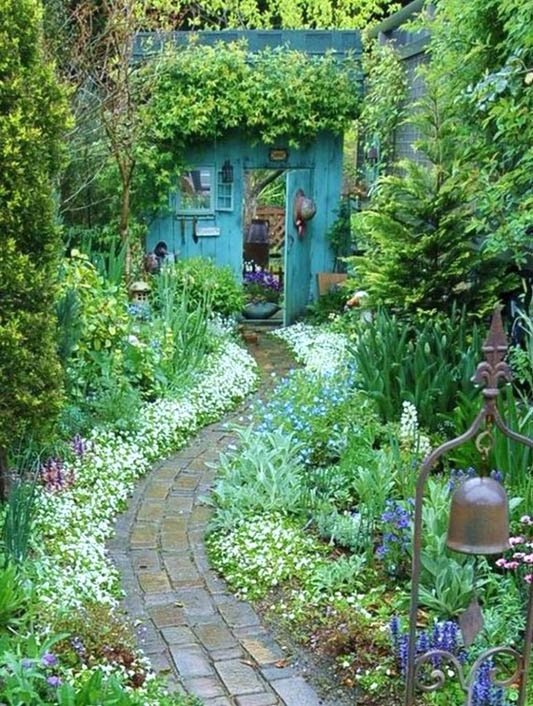
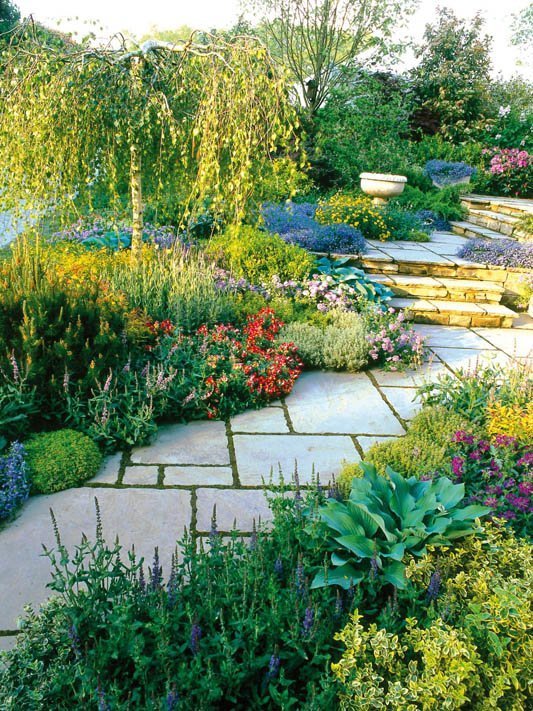
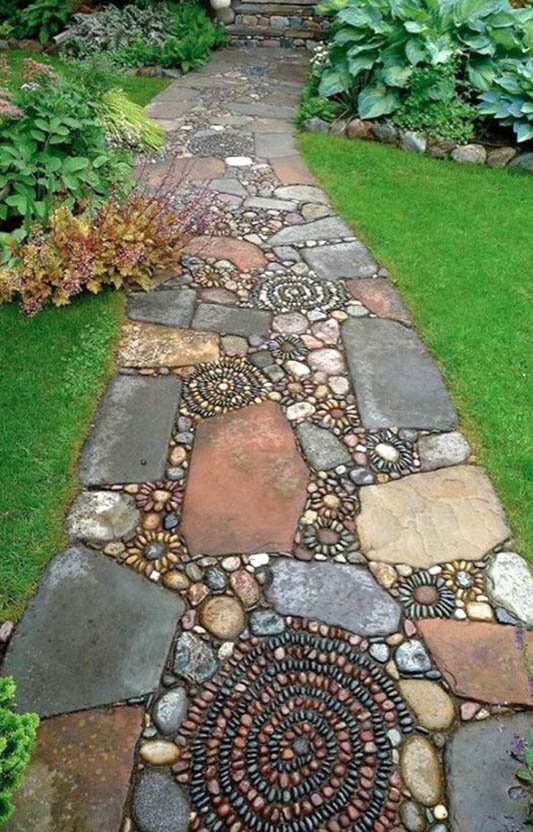
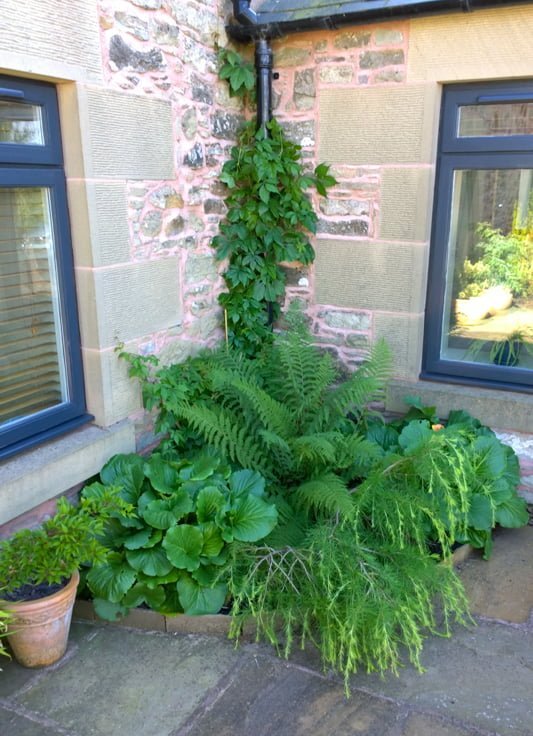
When it comes to beautiful garden design most people fail to consider the importance of the garden path. A path can just be a simple route from A to B, but it can also be the backbone of your garden design. A path can transform the appearance of your garden and how it’s used. Either way, a creative garden path could hugely improve your garden.
The practical benefits of a garden path
Take the same route from your backdoor to your garden office, compost bin, shed or garage a couple of times daily, and in a rainy year, your lawn could look like a mud bath. In a bad November you may need wellies just to reach the garage.
The best way to rescue your lawn is to build a path. Not only will you avoid the trench effect, but you could make your garden look longer, wider and more interesting.
Unusual garden path ideas: create an optical illusion
There are lots of clever tricks of the trade when designing a creative garden path. For example:
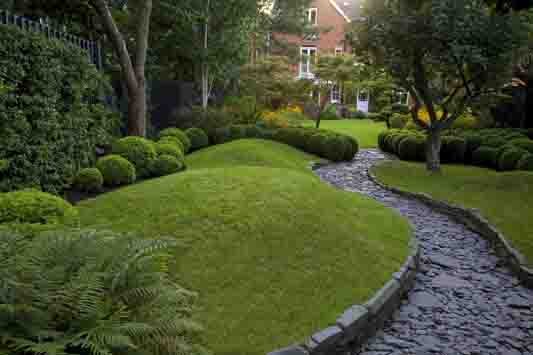
a path starting at 45 degrees from the house, and curving sinuously can make a garden look bigger and wider
a tapering path that narrows at the end of the garden can make the whole garden look longer
a path can steer the eye towards the garden’s best features, from an attractive garden building to a beautiful shrub. It can also create greater cohesion between your home and different garden buildings, or act as a divide, creating a route through different planting zones
solar powered lights can highlight a path at night, or even change its colour
The best material for a garden path?
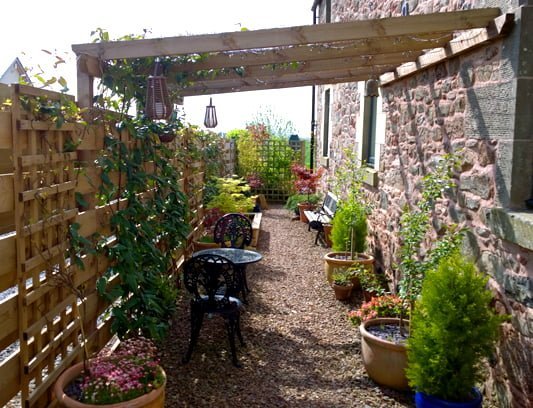
The crunch of a gravel path is always satisfying; other benefits of gravel include:
it drains really well
it’s good value for money
it’s easy to lay
it has a low environmental impact
it can improve security (it’s very difficult to walk on a gravel path around a house without making noise)
And though gravel paths are not the most exciting option around, visual interest can be increased by breaking up the gravel with groupings of natural stone or granite slabs. Or you could try planting ground cover perennials, such as alchemillla (ladies’ mantle) in the gravel.
If you’re looking for other garden path ideas there are lots to choose from. Cheap materials for pathways include wood bark, pebbles, wood chips or stone chips, the last of these available in a wide range of colours.
If using coloured stone chips, remember that the colour will intensify when they are wet, so choose your shade with that in mind. You should also consider the impact of the stone colour on neighbouring plants too. Neutral colours can help blend a path into its surroundings, whereas a contrasting colour such as white granite or grey/blue slate will make the path stand out. Whatever you decide, if you use gravel, bark, wood or stone chips it’s best to put a layer of weed proof membrane underneath to minimise future maintenance.
There are a vast range of other possible materials for an interesting garden path; from traditional York stone (either new or salvaged), to recycled bricks, modern concrete, wooden sleepers or even raised decking. Decking can also add height to your walkway, which adds extra interest.
Each material has its pros and cons, in terms of price, durability, drainage, ease of use, and general appearance. You can get a good idea of what’s available in your budget range on the Jewson website.
Garden path edging ideas
Edging a path will prevent gravel or chips from migrating into the surrounding grass, and also make it look smarter. Possible edging materials include timber (which should be treated pleasure-treated with preservative), terracotta or slate tiles, or modern steel edging.
The best width for your path will partly depend on the size of your garden. Also entering your decision-making should be:
narrower paths tend to encourage people to walk faster; broader paths offer more of an invitation to stroll
generally, garden designers recommend a path is wide enough for two people to walk side by side, but a practical A-to-B path to a bin or shed can be narrower
think about practicalities – whether you need enough width for a wheelchair or lawnmower, and if you should leave a gap in the edging to allow easy access for a wheelie bin or wheelbarrow
A straight garden path v. a curving garden path
The shape of the path depends on your taste and the space available. A meandering or curved garden path will generally make your garden look more interesting or bigger, but may not be practical if your family are likely to head for the bike shed or workshop by the shortest possible route.
Curved paths are also relatively easy to make yourself if you intend to use materials such as gravel or woodchip. However, you may need a professional garden landscaper to lay a curved garden path made of paving slabs or timber decking.
Straight paths are more likely to be used in larger, formal gardens, and may do little to enhance the design of a smaller garden. But if you want to add visual interest to an existing straight path, the options include:
a pergola or arches to walk under
a fountain, water feature or pond with a bridge to walk over
interrupting the straight line by adding a paved area or bench part way along the path
alternating between two different materials, such as mix of slabs and woodchip, or “stepping stones” slabs surrounded by gravel of a contrasting colour
There’s excellent guidance on building gravel, concrete or block paving paths on the Wickes website, and this also tells you all the materials you’ll need. From a spirit level to check that the base is level, to weed-resistant landscaping material for the base, to the right type of mortar.
If you follow these seven creative garden path ideas you could end up improving the look of your garden as well as making it feel bigger. You’ll also be rid of the quagmire that comes with winter weather too.
With many of our customers, we find that buying a summer house or garden room is part of a wider garden design overhaul. And the ideal complement for a new garden building is often a pond – perhaps in another part of the garden, or possibly built into a decking area or on a patio by the summer house.
After all, if you’re planning to spend more time in your garden, a pond can make your garden view more interesting and varied. And it can attract a huge variety of wildlife – from hedgehogs to dragonflies to frogs and newts, which as well as giving you something to look at, can also help to control slugs and snails.
A fountain or waterfall, either connected to the mains or a solar panel, can also add another dimension to your pond. Sitting on the decking outside your summer house can be very relaxing; add the calming sound of running water to the mix and you’ll be in heaven.
Making a garden pond is no longer the DIY project from hell
Go back a few years (or decades) and building a garden pond could be the DIY project from hell. I’m sure some of you have a few childhood memories of the bad old days of trying to build concrete or clay-lined ponds in the back garden.
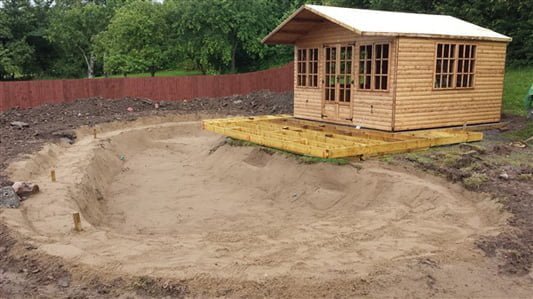
Fast forward to today, and these projects are far easier, with a huge choice of liners, both molded and flexible. Possible materials include fibre glass, PVC, butyl and EPDM; they all ensure that making a garden pond is a lot easier than it used to be.
The affordability and range of mini-diggers also allows for a large pond to be dug in even an average sized back garden (or one with ground too difficult to excavate by hand). A summer house with decking overhanging a large landscaped pond is no longer the complex and expensive task it once was.
Choosing the best garden pond liner
The advantage of molded or preformed pond liners is that they don’t puncture or tear, but they don’t allow you much flexibility in the design (typically rounded triangles, rectangles or squares with two different depths). In contrast, PVC, butyl and EPDM liners are cheaper, and used much more frequently, but are more susceptible to leaks (a good layer of sand, or even carpet underlay, is recommended under such pond linings).
There’s also a material called Bentomat, which is ‘self-mending’ and made from natural materials. It’s easy to install and is often used for large-scale constructions such as canals or fisheries, but can also be used at home to make a small garden pond.
As well as researching pond liners, you’ll need to think about where you position your pond. You’ll probably want to have it somewhere you can see it – either from your house, or from your new summer house. Partial shade is recommended, since too much sunlight can encourage algae growth. But water plants will also need sun for part of the day, so avoid all-day shade.
Having trees overhanging the pond is not ideal, as you’ll have to spend time removing dead from the leaves. Tree roots could also end up puncturing your lining.
It’s a good idea to avoid building the pond in a spot that is boggy or marshy. You wouldn’t think this would matter, but having a high water table underneath the pond can cause damage to the liner when the water level rises.
There are good tips to get you started on a simple rectangular liner pond with a decking surround on the Gardeners World website. If you want more nuanced ideas on shape, position and designing a pond, take a look at World of Water.
One solution for areas where digging isn’t possible, or the water table too is high, is to have a raised (or partially raised) pond. You won’t get rising water (or roots) damaging your liner, and raised ponds can often be safer for children and animals than sunken ponds.
A further benefit of raised ponds is that, with less digging and excavations to do, they can be easier to build (for instance, making a garden pond out of timber is a lot less backbreaking than excavating heavy clay soil). They can stand on pretty much any sturdy surface, as long as it is stable and can bear the weight of the water, such as concrete, paving, earth or decking.
Finally, if you plan to watch your own garden wildlife show from your new summer house, you’ll need a wildlife-friendly pond. For example, it’s vital to think about how small animals or amphibians will get in and out of it. Clearly, raised ponds are less mammal-friendly; and so are ponds with steep sides, where animals will struggle to get out.
Instead, you’ll need gently sloping sides, and perhaps a beach or ramp made out of stones or pebbles. You’ll also need a range of plants that are wildlife-attracting and can help oxygenate the water (particularly if you want to keep fish, and like clear rather than murky water). If you get the right mix of plants you can attract frogs, toads, newts and dragonflies, and other creatures such as birds and hedgehogs may well use the pond to drink.
Once constructed and planted, your garden pond will soon improve the look of your garden. It will give nature a helping hand, offer a beautiful view from overlooking windows or the summer house, and when combined with a fountain or some subtle underwater lighting, a relaxing addition to the patio, border or decking.
There’s a lot of talk about man caves recently, but here’s something less familiar, the “she cave” or “she shed”. All over the country, old sheds are being renovated, or new ones installed, as women take over gardens and backyards. No longer are garden sheds and workrooms the preserve of men only.
You’ll find plenty of inspirational ideas for garden she caves online – yoga havens, hobby rooms, temples to pink, 50s diners recreated in someone’s backyard, beach huts transported to a suburban garden, or an oasis away from TVs, PlayStations or children asking for food.
And if you go beyond the stereotyping, there are plenty of other uses for a well-built timber she shed. Somewhere to write, paint, or store your collection of power tools. Somewhere to start a business, so you can work at home and avoid the tedium of commuting.
And most important of all – somewhere that belongs to you, where you don’t have to compromise on taste in design, or trip over someone else’s belongings.
This applies equally to she sheds and man caves. If you want a living space entirely themed to Star Trek or Downton Abbey, then having your own garden room is probably the best way to do it. And if those aren’t your thing, but you still want a timber she cave, then here are a few of our top selling garden rooms.
Best garden she shed for a tight budget or a tight space
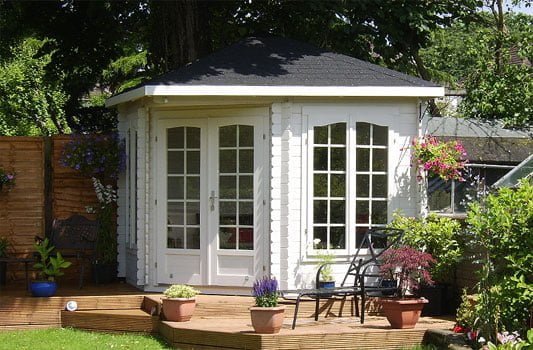
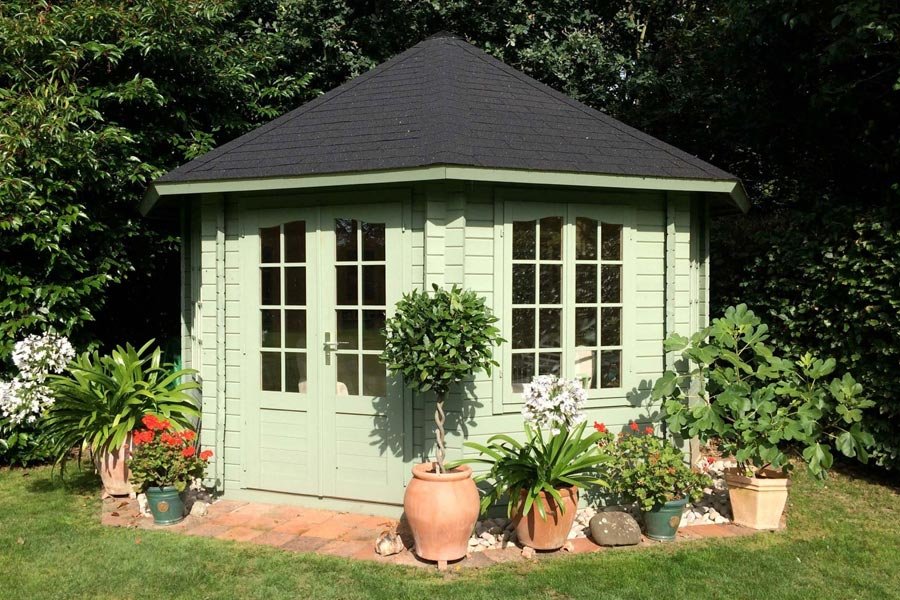
Our GL27 garden building is a low-cost summer house that won’t eat too far into your wallet or your garden. The corner design lets light flood in through the double doors and full-height windows, and it’s spacious and airy. It’s an ideal space for a glass of prosecco and some good chat. The perfect, low-cost, timber she cave. If you like the corner design but would like something bigger, you could try the Nene summer house (shown in the feature photo at the top of the post).
Best timber she cave for a workroom or hobby room
There’s some serious storage space in the GL87 timber cabin, so this would be an ideal she shed if you want to store materials or tools – from canvases to sewing materials to fitness equipment. And imagine the joy of not having to share your storage cupboards or drawers with other people’s stuff!
The cabin has 34mm timber walls, meaning it is insulated enough to use in the cooler months – a true year-round garden she cave.
Best garden she cave for a yoga room
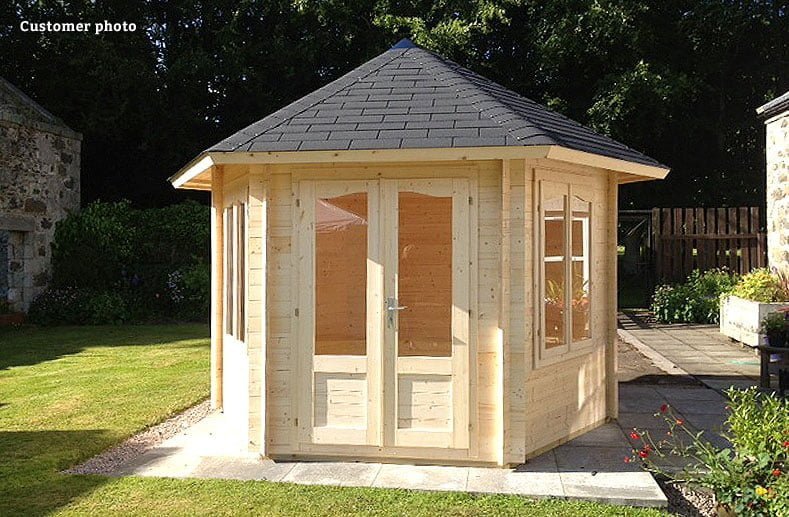
The hexagonal Hareford pavilion measures over 3m in diameter so there’s plenty of room to stretch out your yoga mat. And you can enjoy 180-degree views of the garden while you do your Downward Dog.
With 34mm timber walls and a 19mm real wood floor, it would be snug and warm on a rainy day. It’s available on 8-10 day express delivery, so you wouldn’t have to wait long to treat yourself for that she cave you’ve been longing for.
Best she shed for a day bed
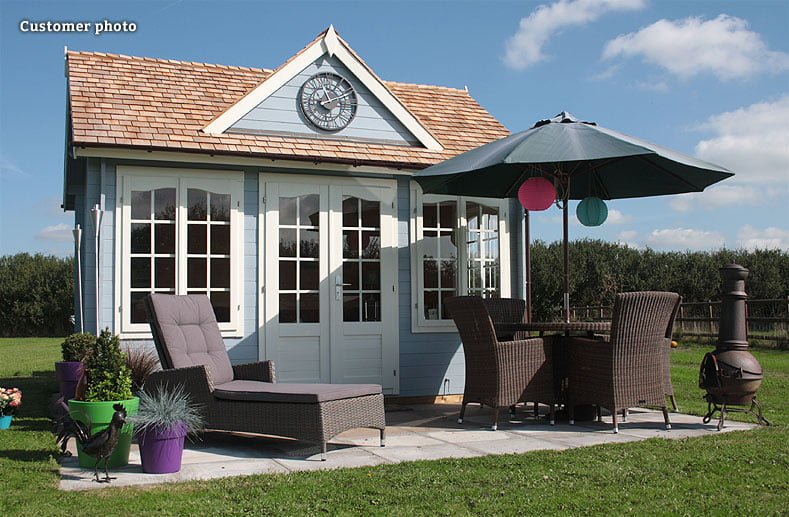
Yoga, workrooms, gym equipment … this is all becoming a bit energetic. So, here’s a perfect backdrop for a day bed – the Wye summerhouse with a traditional clockhouse design. There’s also room for some comfortable chairs, or a writing table or art area in case you ever want to pretend you’re busy.
Best garden she cave for a change of lifestyle
Our Finn garden room would both make an ideal home office. With 44mm timber walls and double-glazing, it’s intended for all-year round use, and the stripped-back design looks professional and modern.
You could use it as your own home office, with room for storage space, IT equipment and work materials. Or, with its 5.3m by 3.8 dimensions, it’s also big enough for customers to visit or for a desk for a colleague.
Just imagine – no more commuting for hours to the office; just a quick walk across the garden to your beautiful she cave/office, and the excitement of running your own business and taking control of your life.
And just to make the process even easier, Finn measures less than 2.5m high, so most people won’t need planning permission to install it in their garden (though you should check this, because regulations in some areas are different).
We could show you many other ideas too – best she sheds for impressing your friends; best she caves for entertaining; best she sheds for a home gym, but it’s probably best if you browse around our site yourself, and give free rein to your own day dreams for a space of your own…
If you want to learn to grow your own fruit you will be rewarded with an improved diet and a more beautiful garden, not to mention the fact that you’ll helping out pollinators such as bees and butterflies (and reducing your carbon footprint). But there are so many fruits you can grow in a British garden; where do you begin, how much space do you need, and how easy are different fruits to grow?
1. Strawberries: A quick (and delicious) fruit fix
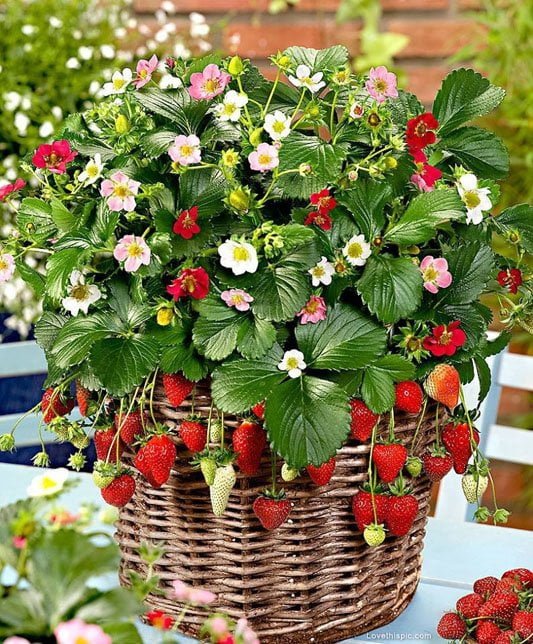
If you’re looking for quick results and ease of growing, you may well start with strawberries. They can be grown in garden beds, containers, pots, grow-bags and even hanging baskets. They can thrive anywhere as long as they get enough sun (a pot of strawberries growing on a kitchen windowsill looks great), and there are plenty of tips on growing strawberries to be found on the RHS website.
2. Rhubarb: great for reluctant gardeners
When it comes to growing your own fruit, even easier than strawberries is rhubarb, which grows well in sun or partial sun, and even in poor soil. The results won’t be instant – you should wait until a plant’s second year before harvesting – but the plants need minimal maintenance. And since rhubarb is usually ready to eat from April, it won’t add to your late-summer/autumn glut if you are already growing soft fruit or fruit such as apples, pears and plums.
There’s a useful guide to growing (and cooking with) rhubarb on Jamie Oliver’s website, but remember, rhubarb leaves are highly toxic, so don’t cook them or let children eat them.
3. Looking for a more unusual fruit to grow? Try quince
One good option is to grow fruit that isn’t readily available in supermarkets and other shops. The quince is a great example, tasting similar to a cross between apple and pear.
Quince trees don’t stand up well to late frost, so may not be suitable for northern gardens. But, other than that, they should do very well in most British gardens – including urban or coastal gardens – as long as they get sun and some shelter. They can also be grown in containers (which is handy if you want to move the plant to a more sheltered spot during the winter).
Once you have grown your quinces, what can you do with them? Well don’t start by eating them straight from the tree – they really need to be cooked before they are consumed. They’re brilliant turned into jams, jellies (as an accompaniment to meat, especially game) or for baking tarts and crumbles.
4. Up the stairs, apples and pears
Admittedly, quince may be a bit esoteric, so let’s go back to the mainstream. Apples from your own tree taste so much better than shop-bought versions; growing your own also gives you access to varieties beyond the usual supermarket Granny Smiths and Gala…
First points to decide are whether you want to grow apples in a container or in the garden, and whether you want dwarf or full-size trees. As you would expect, the Royal Horticultural Society website has lots of advice on choosing and tending apple trees. Thompson & Morgan has a good selection of easy to grow apple and pear trees, and the excellent information about each variety will help you choose the best one for you and your garden.
A good garden centre will also be able to help you choose the best variety for you and your garden. If you’re short of space apple and pear trees can be trained to grow along a wall (ideally south facing), or if you want to do something unusual, you can make an architectural feature out of the trees by training them to grow into an arch or tunnel (so you can walk through and under the branches).
Maintenance of apple trees is straightforward – they may need watering in dry periods, especially if they are newly planted or in a container, and will need pruning once a year.
5. Berries and currants
The old-fashioned British garden wasn’t complete without a selection of berries and currants growing – from raspberries to gooseberries to blackcurrants. Most of these will thrive in British weather, and don’t require much in the way of maintenance (apart from the occasional prune, and possible netting in late summer if the birds in your garden start getting a bit peckish), so they are ideal if you want to learn how to grow your own fruit.
There’s excellent, straightforward advice on planting fruit bushes on the Homebase website – which type you choose to plant may depend on which you like eating most!
6. Look to the continent
If you want to learn to grow your own fruit but think apples and strawberries are just too traditional, you could try olives, figs, citrus, apricots or peaches. If you’re the owner of an exposed garden in the north, this may be challenging – outdoors, at least – but gardeners in southern England should have more luck.
According to one gardening expert, climate change is opening up new possibilities for growing fruits such as apricots and figs. It’s also making it easier to cultivate a more interesting choice of plums – for example, French-style varieties such as mirabelles.
Olives should do well in an unheated greenhouse or conservatory, and should grow outside if you have a sunny, sheltered garden. They generally take 3-5 years to produce fruit, so patience will be required. If you want to try this at home, there’s easy-to-follow advice on the Eden Project website.
A tree with 40 different types of fruit? It sounds like a hoax, but what started out as a rather eccentric idea has turned into a wonderful reality. By way of grafting branches of different fruit trees onto one plant, Sam Van Aken has created a real tree that blossoms and later bears 40 different varieties of fruit (just watch the video above). Whilst this epic undertaking is probably beyond the gardening talents of most people, it may be worth considering as a point of inspiration: if you are short of space and don’t have room for any more trees, how about asking a neighbour for a clipping from a different fruit tree and grafting it onto one of your own trees? You may end up with one fruit tree with a few different varieties of fruit!
8. Learn to grow your own fruit: further inspiration
A shed is “a slight structure built for shelter or storage or for use as a workshop”, according to the Oxford English Dictionary, but that old-fashioned definition of the shed seriously underplays the possibilities of the modern shed (especially our best posh garden sheds).
To be sure, 21st-century sheds can provide shelter, storage and workshop space. But they’re certainly not all slight. And they’re also being used as offices, entertainment spaces, extra rooms, dens, summer rooms, workshops and much more besides.
Given the way that sheds have metamorphosed in the past few years, it’s not surprising that many people are now talking about ‘posh sheds’. It’s a great way to distinguish them from the old-style lean-tos where people kept their gardening tools.
At the same time, don’t let the term ‘posh shed’ cast a false impression. It doesn’t have to be the type of grand or eccentric design you’d see on TV programmes such as Shed of the Year. Nor does it have to cost a five-figure sum, contain an Aga, or house your very own garden pub – despite some of the articles you might see in newspapers or magazines.
What we really mean by a ‘posh shed’ comes down to three basic elements:
High quality construction
Range of use
Beautiful design
1. The construction of a posh garden shed
At GardenLife, our first criterion for a garden building to count as ‘posh’ is that the construction and materials are first-rate. Importantly, the timber used is dense and robust, and solid enough that you can spend time in the shed on cooler days (without having to pile on multiple coats, scarves and gloves).
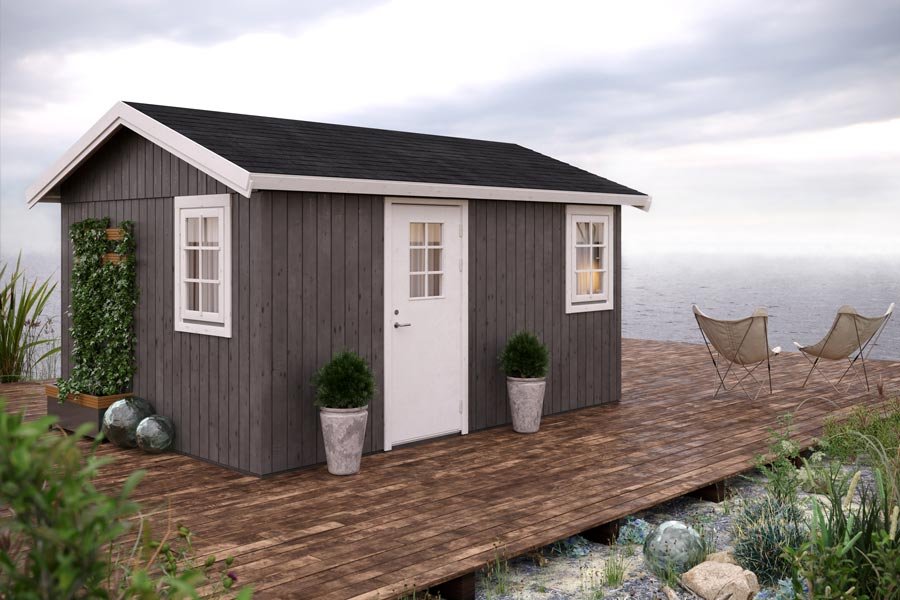
For instance, our Roe beachhouse design (below) and Truro log cabin style designs (feature image above) are suitable for gardens with limited space – i.e. you don’t need a country estate to install them. But, they’re made from 28mm solid timber with superb insulation qualities.
They’ve also got real glass windows, and solid timber roof and floor; there’s not a trace of OSB board or plywood to be found. Owing to their high-quality materials, they’re insulated enough to use through spring and autumn, and has excellent longevity and durability.
The quality is also apparent in small design details such as the quality of the fittings and the front overhang that gives protection from sun or showers. So, these sheds are posh, whilst still being affordable.
There’s a similar story with another of our best posh garden sheds, the Ure garden room. The design isn’t flamboyant and won’t alienate the neighbours, but look carefully and it’s far from being your run-of-the-mill garden shed. With 44mm timber walls, it offers exceptional insulation – meaning you can have your New Year’s Day lunch in there, as well as drinks on a summer evening.
2. The uses for a posh garden shed
There are basically no limits to the uses for a posh garden shed (at least within the limits of the law). Our customers use them as places to entertain, chill out, run a business, do yoga, play the drums, star gaze and any number of other things.
Take the versatile Brook, a shed that’s of such quality and style that we call it a log cabin. Some of our customers go the traditional route of using it to store garden equipment or mend their bikes. But others use it as a writing room, man cave or kids’ playden.
In effect, then, a posh garden shed is a way to get more living space, without the hassle and expense of building an extension. Or to improve your lifestyle, through entertaining in greater style, starting a hobby, working from home, or having your own space. What else is it about our best posh garden sheds?
3. The design of our best posh garden sheds
One other way for a shed to be ‘posh’ is in the design and styling, and the only limits here are your own style preferences (and perhaps the planning permission rules where you live).
Those who prefer more contemporary styling also have the options of sophisticated modular designs, such as our modern Fiona garden room. It’s popular with customers as a garden office, and its double-glazed windows and insulation options make it ideal for year-round usage.
Modern styles like Fiona (above) are also quick and easy to assemble yourself – fortunately, not all ‘posh’ sheds require weeks to make, advanced DIY skills, or the services of an artisan shed-builder.
Adding your own design details can also make your shed ‘posh’ – from exterior paintwork to the furnishings inside. Sites such as Pinterest can provide excellent interior design ideas, and you can even check out our customers decorating pics. Or, if your posh shed already has first-rate timber, construction and fittings, you may prefer to keep it simple and let the quality of the materials speak for itself.
Either way, you can sit back and bask in some serious shed envy from the neighbours if you decide to enjoy one of our best posh garden sheds.
Gardens can look desolate in March, despite the valiant efforts of spring sunshine and blooming snowdrops, daffodils and crocuses. Lawns can look ragged, pale and full of moss, flower and vegetable beds bare, and the ravages of winter storms are on full display. Even so, March is also an exciting time for anyone with a garden. The days are longer, there’s some warmth in the sun, and it’s time to get started on creating a beautiful (but practical) living and entertaining space for the summer. Here are some top tips for spring gardening jobs.
1. Hold back on the seeds
With shops full of seeds, the temptation is to get planting immediately. But don’t start sowing too early in March. We’re still likely to have some frosts, especially in Scotland and northern England, and you should wait for the ground to warm up. But there are plenty of projects to start instead, and you can also start planting some veg in the greenhouse or indoors.
2. Go on pest patrol
Take action against slugs, which could ravage new spring shoots, especially hostas. Whatever your preferred methods – physical, organic or chemical – for protecting your garden against slugs, it’s time to deploy them. Onto more spring gardening jobs.
3. Your lawn needs you
Early spring is the time to get the lawnmower out of storage. If you have a few rain-free days, and the grass is dry, do a gentle mowing session, with the lawnmower on its highest setting. If the lawn is particularly long you might want to consider cutting it one day on a high setting, then the next day going over it again on a slightly lower setting (trying to cut a long damp lawn on a low setting could stress the lawn mower and wear you out too). The RHS website has lots of advice on cutting lawns in early spring.
4. Be nourishing
Top dress containers with new compost, ready for the growing season, and consider adding some plant food or bonemeal to help and sustain healthy growth. You can also tidy borders, and mulch them with compost or manure. If you have a wood burning stove you can add your wood ash to beds and the carbon will help invigorate the earth. The soil has a hard summer ahead, and needs all the nutrients it can get.
5. Deal with weeds
It’s useful to tackle weeds early in the year before they get out of hand. It’s also easier to spot them if beds and borders are relatively empty, and remember to check cracks in patios and paths for weeds too.
6. Get busy in the greenhouse
Before your greenhouse gets too cluttered with seedlings, or festooned with summer tomatoes, take a good hard look around you, and notice the dust, cobwebs and dirt. It’s a dirty job, but one of these essential spring gardening jobs.
Cleaning and disinfecting benches, floor, windows and even pots and seed trays will help get rid of any diseases or bugs that have wintered in your greenhouse. Jeyes Fluid is widely recommended, or garden centres may recommend other products. Make sure everything dries and ventilates thoroughly before you start planting seedlings and cuttings.
7. Get the really boring jobs over for the year
Repair post-winter fences and trellises; clean and sharpen gardening tools; and tidy the garden shed so that you can reach the lawnmower without falling over two spades and a sunshade. Maybe make a shopping list of all those things that you regularly need throughout the year, such as buying some extra compost (if you don’t make you’re own), plant food, new tree stakes and ties, and pest control pellets. Much better to do these jobs now and have supplies read when you need them.
8. Make plans for your garden
Although the site of snowdrops and late frosts make it too early for some planting, it’s not too early to plan. Get looking at catalogues, websites and the like, and try something new. Check out our garden design ideas and inspirational photos on Pinterest. If you leave this until June or July, you’ll just be kicking yourself that all your amazing new discoveries needed to be planted out in April.
9. Think big
The emptiness of a March garden makes this the best time to dream up a project. Look around you with a fresh but harsh eye. Do you really like those shrubs in the corner? Has that beloved forsythia actually grown far too tall? Has the buddleia taken over a favourite corner? Would the end of your garden become much usable if you installed a summerhouse? Wouldn’t it be wonderful to work in a garden office this summer?
10. More advice on spring gardening jobs
Without further delay, get browsing, whether it’s a seed catalogue; a social media site with ideas for patios; or a collection of garden buildings or summer houses. Your plans may turn the Easter break into a gruelling 72-hour DIY or gardening marathon, but they will set you up for a wonderful garden summer.
For other good ideas on spring gardening jobs, there’s some great advice at:
The weekend newspapers (or their archives) are also a good source of seasonal gardening advice and spring gardening jobs. A word of caution though – national newspapers may well be geared towards readers in southern England. If you live in a colder, northern area, you may want to delay their advice by a fortnight or so.
Winters (and summers) seem to be getting wetter, so if you’re fed up of not being able to use and enjoy your garden when it’s wet, check out our guide to the best design solutions that incorporate a patio, pergola or gazebo:
Look down, look up
Where to start when considering how to ensure your garden in the rain
You don’t need us to remind you it’s been a wet winter. Even if you were lucky enough not to have your home affected by flooding or storms, your garden may well still bear the scars. Mostly in the form of mud and waterlogged paths and sodden lawns. So, given that we may get similar wet winters (and summers) in future years, we’ve put together some easy-to-manage garden design ideas that should take you through rain, more rain, and mud – whatever the season.
Look down, look up
Solution 1 is to think about what’s underfoot, using patios and paths to create dry areas whatever the weather. So, as soon as the rain stops, you can get outside without sinking into mud or grass-turned-bog.
Solution 2 is to think about what’s above, using pergolas, gazebos and other garden buildings to create some shelter from the rain. And, fingers crossed, they will also help you shelter from the overhead sun if there’s a good summer.
The beauty of both solutions – patios or gazebos – is that they can be relatively simple DIY projects.
Garden patio checklist
As well as providing a mud-free area, patios can add interest to a garden, and act as a focal point. And they don’t automatically have to be next to the house.
A few basic rules:
A good strong base is crucial, with sand and gravel usually recommended
How thick the base should be depends on the soil and drainage in your garden
The patio should sit slightly above the surrounding area so water can drain off
The patio shouldn’t be completely level and should be edged by gravel to allow heavy rain to quickly soak away
When digging the base, stay well away from places where you know there are tree roots, or utilities cables and pipes
More exciting than the practical dos and don’t s is choosing materials and patterns. On materials, you’ll find huge choices of new or recycled pavers at DIY stores and builders merchants. Recycled bricks and stones are an eco-friendly option – you can either re-use them as they are (though this will usually entail having colour variations) or buy new pavers made from recycled materials.
On patterns, there are five basic patterns: circular, herringbone, basket weave, European fan pattern, and running bond. Or for a more ambitious choice of patterns and layouts try Paving Expert, this has useful grids, which you can adapt for your own garden on graph or squared paper.
If you do want to build your own patio as a spring project, there are hundreds of websites and YouTube videos giving step-by-step instructions. If you want to take your patio to the next level, then covering it with a pergola or wooden gazebo is the next step.
The patio pergola combination
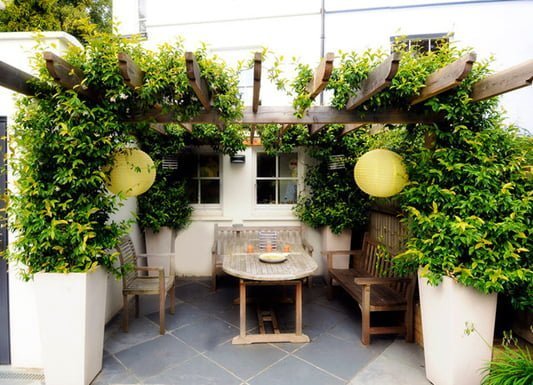
Obviously, the best way to enjoy your garden during rain is to buy or build a cabin, workroom or summer house. But if that doesn’t fit your budget or garden design, a pergola can provide visual interest and weather shelter.
The idea of the pergola dates back to the Italian Renaissance, when people started to use wooden structures with crossbeams and climbing plants to create shade. Some were just focal points for the eye – a beautiful arch of plants at the entry to a garden. Others were more like a tunnel of shade – somewhere to stroll or sit away from the sun.
Whilst finding some shade may not be your immediate priority, a pergola could be a great spring DIY project that would perk up your garden design all year round. And the design style doesn’t have to be traditional – nowadays you’re as likely to find minimalist pergolas using modern materials.
There are some beautiful ideas for pergolas on the HGTV website; check out the wonderful outdoor reading room, with grass coming through the pavers.
The all in one solution: a self-build garden gazebo
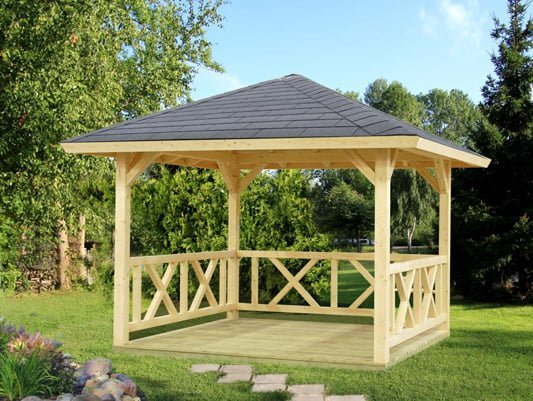
A step up from wooden pergola is the garden gazebo; gazebos are typically built from timber and incorporate a pitched roof to ensure the occupants remain dry even when it’s pouring. Gazebos range from simple square shape designs to more unusual octagonal bandstand-style gazebos, and other gazebos feature window proofing too (protecting you from the prevailing winds whilst remaining light and airy.
Gazebos typically feature a wooden decking area, an alternative to patio pavers which aren’t everyone’s cup of tea. However, a wood gazebo could easily be built over an existing paved patio, or fixed onto decking.
If you don’t want the hassle of designing and installing a patio decking then you could consider a wooden gazebo designed for home install, as many of these come with timber flooring. Gazebos are handsome, affordable and easy-to-build, so if a DIY pergola sounds too much for you, buying a self-build gazebo might be the best option.
An added dimension
Finally, if you do want a plant-bedecked gazebo or pergola – whether traditional or modern in style – there are easy planting suggestions at Perfect Pergolas, including vines, clematis and honeysuckle. Jasmine is also a popular and fragrant option and there are ideas and recommendations for climbing roses for pergolas on the Royal Horticultural Society website.
Having planted them, you’ll need to persuade them to grow beautifully around your structure, for example, using pruning or training the stems to avoid the common problem of having bare stems lower down the gazebo.
Patio, pergola or gazebo?
Obviously it takes time to create a patio, pergola or gazebo – in particular growing plants, but with a self-build timber gazebo, you could easily have one in place for summer. If you have any questions about any of the GardenLife garden gazebos please don’t hesitate to get in touch.
Until a few years back, there were five ‘typical’ British family pets: dogs, cats, rabbits, guinea pigs and hamsters (in no particular order). But there now seems to be a sixth on the list: chickens. Keeping chickens is now a fairly common practice in suburbia, and the humble hen is a regular inhabitant of the UK’s back gardens. The benefit of keeping chickens is clear: not many other pets lay you an egg most mornings!
They also make friendly pets: there’s something very endearing about a free-range hen racing across the garden to greet you, with a level of enthusiasm that only a dog could equal. The clucking of contented hens also adds a new level of homeliness to a back garden.
Which henhouse is best for keeping chickens?
The rising popularity of back garden chicken-keeping has been fuelled by the growing range of henhouses on the market, in particular, the plastic ‘Eglus’, available in multiple colours from Omlet. The compact designs fit easily into even small-ish back gardens, need minimal maintenance, and are easy to clean (this is important for keeping the hens parasite-free). Prices start from £235.
If you’re not a fan of brightly coloured plastic, and want a more traditional timber henhouse, the same buying principles apply as with any timber garden building. Look at the quality of:
the timber – you want dense, robust, slow-grown softwood timber for extra insulation and longevity (or if the budget allows, hardwood)
timber treatment – ensure that the timber is treated with a pet friendly wood preserver to enhance its lifespan
the fittings – you want them to be solid and rustproof
the construction – look for pressure-treated foundation joists, a strong build and a good-quality roof
You should also pay attention to ventilation: chickens are vulnerable to respiratory problems, and ammonia can build up from their droppings.
How much space do I need for keeping chickens?
According to PoultryKeeper.com (a great source of advice for would-be hen owners), each chicken should have a minimum of 1 sq metre in the run, though 2 sq m per bird is preferable. If space in your garden is limited, it’s possible to buy high-rise runs, such as Omlet’s Eglu Go Up coop, where the run is underneath the henhouse.
Keeping chickens in a back garden; do I need permission?
In the UK, you do not generally need permission unless you want to keep 50 or more chickens (in which case, you need permission from Defra – the Department for Environment, Food and Rural Affairs). However, you may be subject to byelaws, lease conditions or the deeds to your house preventing you from keeping chickens, and there are rules that may apply to back-garden poultry keepers. Interesting, laws relating to livestock also apply to chickens, and there have been instances where local councils have been involved in cases with ‘nuisance’ hens (more on that below).
In the first instance you should always also consult neighbours. Chickens can be noisy (eg when laying eggs, or when keen to be let out of their henhouse on light early mornings); smelly, if their henhouse is not cleaned weekly; and damaging to neighbouring gardens if they repeatedly escape. If you have neighbours who are proud of their immaculate garden they will be far from happy if they see escaped hens digging up their meticulously planted flower beds!
If your hens do regularly escape it will be your responsibility to stop this from happening, and you can do this quite simply by running chicken wire or plastic trellis around the bottom of your fence or hedge. If your hens are able to fly over boundary fences then you can clip their wings, keeping them on terra firma. It really is worth doing both of these things as persistent damage to a neighbours gardenscan quickly turn even the best of relationships sour. In an article on problem chickens David Fleming (head of the property litigation department at William Heath & Co.) outlined that under the Animals Act 1971 that people who keep chickens in suburbia are liable for “damage caused by trespassing ‘livestock'”. If things turn nasty between neighbours action can be taken by way of the Council Environmental Health Officer, and chicken owners are liable for damage caused by escaping chickens (as well as costs incurred).
If you’re thinking of keeping chickens in your own back garden then you really need to check with your neighbours first, and also ensure that your hens cannot escape. Many of the other associated problems can be minimised – for example, there’s good advice on reducing noise in this PDF. The occasional gift of freshly-laid eggs can also keep neighbours well disposed towards the hens.
How many chickens should I buy?
Chickens are gregarious birds and need company. Common advice is to buy three – this means that if one dies (and, sadly, chickens are vulnerable to a range of problems, from respiratory problems to foxes), you are not left with a depressed, lonely hen. Also, if you intend to buy young chicks it’s best to do so in summer; young chicks can’t cope with cold and can be killed if the temperature drops too low at night (for instance, if there’s an unexpected frost late in spring).
Should I buy a cockerel?
No! In case there’s any confusion about that, no! Unless you live in the middle of nowhere, have no neighbours and intend to breed chickens, then there is no need to buy a cockerel. Hens are perfectly happy without a cockerel, and cockerels don’t lay eggs but they do consume just as much feed (which will push your maintenance expenses up).
In summer, when days are longer, cockerels can crow from as early as three in morning and they won’t stop until midnight (and treble glazing and ear plugs aren’t enough to block out the sound from some birds)! Keeping a cockerel in suburbia is the fastest way to lose friends and alienate people (not to mention the threat of visits from the Council about noise pollution and possible legal action from sleepless neighbours).
Where can I buy chickens?
Forums and advice boards on sites such as Omlet and PoultryKeeper.com should have details about where you can buy hens locally. Generally, look for birds with clean eyes; and an upper and lower beak that meet in the middle. Signs of poor health may include lots of muck on the feathers around the vent; or raised scales (eg sticking out at 90 degrees) on the legs and feet.
Will chickens ruin my garden?
More than likely! Chickens do scratch up the ground with their feet, meaning they can quickly reduce the grass in their run to a dust bowl or bog (depending on the weather), and they can leave droppings on paths, patios and decking areas if they are allowed out of the pen.
If your hens are free-range, you will find they have a particular affection for scratching around in window boxes, posts, containers and newly-planted beds (and they can easily dig up flowers you have just carefully planted). Stones at the base of plants or in pots can help to prevent this, however some hens will gleefully dig up slate and gravel paths in search for worms (spreading stones everywhere).
They may also lay waste to your vegetable patch (unless you fence it off), so although you will have lovely fresh eggs to cook with, your veg may not look up to its usual standard. You can read about which plants chickens eat, or will avoid. Ultimately, if you don’t want your hens to make a mess of your nice tidy garden they will need to be penned in.
Where should I position the henhouse and run?
Chickens can overheat easily, so need the option of shade. But they also seem to enjoy sunbathing, so a mix of sun and shade is ideal. Some poultry keeping websites advise putting the run against a garden wall, as it provides the chickens with shelter and a sense of security. The ground around the run should be even – both chickens and foxes are expert at finding their way underneath chicken wire.
Other than that, it is a question of garden design and individual preference – whether you prefer to have the chickens somewhere you can see them out of the windows or from a patio, or more hidden away from sight.
Whatever you decide to do, when it comes to keeping chickens always check with neighbours first, and if you plan to allow your chickens to roam free-range, ensure that the boundary of your garden is secure. You can then sit back and enjoy the company of a loving pet whilst tucking into a delicious, fresh, free-range egg!
Occasional cleaning with occasional timber treatment on wood framed models
Occasional timber treatment
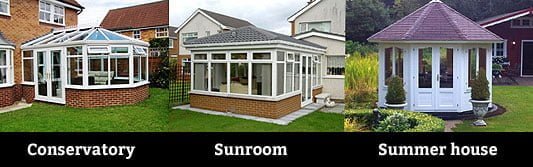
1. What’s the difference between a conservatory, sunroom and summer house?
Conservatories are generally glass (or polycarbonate) rooms attached to a house. A key detail is that the roof is made from glass/polycarbonate, meaning that the sun shines straight into the room. Conservatories can come in different styles, from simple lean-to affairs to large bespoke orangeries. ConservatoryDesigns.co.uk has a good guide to different styles, helping you tell your gull wing from your P-shape.
Then there’s a sunroom, also sometimes referred to as a sun lounge or a garden room. This is also attached to the house, but has a solid roof, offering more protection from overhead sun and heat loss.
And then there are summer houses, and other garden buildings, such as garden offices. These may also be referred to as garden rooms, and can range from a simple timber pavilion to a fully-insulated multi-roomed home office.
2. The pros and the cons of a conservatory
The great benefit of a conservatory or sunroom is that you don’t have to leave the house to get there. Good news during showery weather. And because they are attached to the house, they minimize the space you have to give up in the garden.
However, both conservatories and sunrooms come with less desirable baggage. The anti-conservatory lobby say that a south-facing conservatory is too hot to step into for half the year. But a north-facing version, whilst perfect in summer, may feel Arctic in winter. The pro-conservatory lobby will say blinds and ventilation can tackle the former problems, and insulation and heating the latter. True enough, but these measures can add to the expense, sometimes considerably.
You are also limited in how you position the conservatory, especially if you live in a terraced home or have limited space at the side of the house. If the back of your house faces south, then so must your sunroom.
Lastly, many people find that in adding a conservatory, they ‘lose’ the room it is attached to. A room previously used as a dining or sitting room or a study may now seem more like a corridor on the way to the garden room. These are the main pros and the cons of a conservatory, however good design can mitigate against some of them (but this might require a more expensive bespoke solution).
3. Summer houses – the best alternative to a conservatory?
In contrast to conservatories, summer houses and garden rooms can be oriented any way you wish: for example, a sun room at the bottom of a south-facing garden could have the main doors and windows facing north. And corner summerhouses can be just as space-efficient in a small garden as a conservatory.
And if the 180-degree garden views available in a conservatory attached to the back of a house are insufficient for you, there are summer houses with 360-degree views (which simply can’t be replicated with a conservatory).
Secondly, free standing timber summer houses can offer more space for possessions as well as people. You could devote a corner of your new conservatory to lawnmowers, tools and bikes, but let’s just say the aesthetic appeal might be diminished. Of course, this would apply equally with a beautiful new summer house – hence the appeal of a garden room with a separate secure storage area (so you can keep your messy garden tools separate to your living space).
Ultimately, if you really like the idea of a sunroom extension but the cost and limited floor space is putting you off, a summer house is probably the best alternative to a conservatory.
4. Conservatory versus summer house – the questions to ask
There’s no right answer to the conservatory versus summer house debate. But whatever you buy, the important thing is to choose a style that will be spacious enough, warm enough, cool enough, robust enough, and loved enough by you and your family.
Here are some points to look for when trying to ensure those things:
Look at the quality of materials used – for example, thicker, denser timber offers greater insulation, as do double-glazed windows.
Think about ventilation – are there enough doors and windows to let in air if you want it, and are there tilt-turn windows to add flexibility?
What flooring, insulation and security options are available?
Think about how much of your garden will be taken up by the structure and mark out the area to understand the impact on the garden. Will it be too small or too big?
Following on from the above, consider the overall internal floor space (which will be smaller than the building footprint). Will the conservatory or summer house be large enough to accommodate your furniture or hobbies? Again, marking out actual sizes on the ground can help.
5. The practical part: price and planning permission
How much a conservatory or summer house costs is a difficult one because of the vast range of styles, sizes and designs. A common answer with conservatories is from £5,000 to £30,000, but with bespoke versions the upper limit will be higher. And the design details that make a conservatory practical and liveable – from double-glazing, to ventilation and underfloor heating can bring up the price considerably. Ultimately, adding a conservatory is the most expensive form of extension costing around £200 per sq foot.
With garden rooms, there is also a wide range of prices, depending on the spec chosen – from summer-only pavilion to year-round business HQ or accommodation – but it is usually easier to tell in advance how much the costs are because they are all-inclusive (including the building itself, roofing materials, accessories, delivery and installation, if required). They should also offer a much lower starting price – there are good quality summer houses starting from £1000 and well built summer houses should only cost £20 – £50 per sq foot (including ground work, foundations, roofing and installation, if required).
Finally, there is the issue of whether planning permission is required. With both conservatories and garden buildings, the answer is maybe. It will depend on their size, height, distance from the boundaries of your property, whether they contain sleeping accommodation, and so on. The rules differ slightly in England and Scotland, and also in certain conservation areas. Best thing is to check with your local council or check our guide to planning permission for summer houses.
Lastly, if you’re installing a conservatory or summer house to help add value to your home, remember it will only make your home more desirable and saleable if it is of high quality and well maintained (no one wants to buy a house with a damp draughty conservatory or dilapidated summer house that’s full of junk).
Whether you’re a total garden novice intending to grow some container plants, or you’re 30 years into a passion for horticulture, there are thousands of gardening websites and blogs to guide and/or inspire you. And that’s the problem – there are just too many to choose from. So, if you’re looking for growing tips for a shady vegetable patch or want the latest ideas in contemporary garden design, here are the best gardening websites to bookmark.
1. No surprises for first place
The source of all knowledge about gardening in Britain is the mighty – and very user-friendly – Royal Horticultural Society website. We could go on for pages about the different sources of advice on the site, but here are just a few pointers:
The RHS Beginners Guide really does introduce you to the basics, beginning with how to sow seeds, or advice on what containers to use. Also good for both novices and old-handers is the gardening calendar section, giving you advice about what to do each month.
Widely loved in gardening circles is the RHS Plant Finder, one of the seven wonders of the horticultural world. You fill in a few boxes about, for example, the soil type, amount of sun/shade and moisture in your garden, plus what colour and height of plants you want, and it produces instant plant recommendations. Not only that but it tells you how to grow the plants in question, and even where to buy them.
2. Going organic?
Fennel & Fern describe themselves as “a big happy team of organic gardeners who love the soil under our fingernails and munching on our own homegrown veg” and it’s one of the best blogs that GardenLife Log Cabins have come across; beautifully curated, but definitely practical. The main blog is updated each day with new posts; and you can follow the progress of their ‘dream garden’. There are guides for growing vegetables, regular recipes, and beginners’ tutorials.
Also worth looking at is their Garden Grab site which showcases gardening blogs from around the world. This could also be a channel for promoting your own gardening blog if you have one.
In short, Fennel & Fern are a class act who avoid the common pitfalls of many gardening websites: being too intimidating, too focused on selling, or too home-made.
3. Archived but not forgotten
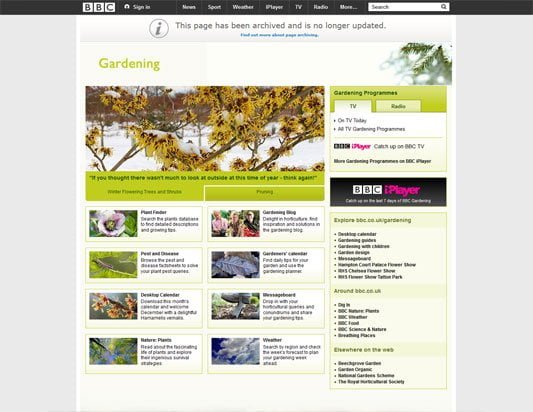
The BBC gardening website will already be familiar to many, but it’s popular for a reason. It has similar features to the RHS site – plant finders, guides on what to do each month, tutorials, and a slightly intimidating series of factsheets on pests and diseases (by the time you’ve looked at a couple of these, you’ll wonder how any plant ever manages to grow).
Although the site has been scaled back in recent years, and blogs and message boards are no longer updated, they are still archived on the site, so there is plentiful material. This includes a great guide to gardening with children with some good activity ideas such as building a wormery, making an indoor cactus garden, or growing a child’s initial on the lawn. Although archived, the BBC gardening website has to be included in anyone’s list of best gardening websites.
4. One-stop-shop for anything you might ever want in a garden
The Gardening Website is a selling website, rather than a how-to website like the BBC and RHS. Some people aren’t taken with its scale and design, but it’s certainly comprehensive. If you’re looking for a specialised dandelion spade, a wide selection of rotavators, or a directory of landscapers or garden designers in your area, this site will take you to where you can find one.
5. One for the indoor gardener
No, not the person who has a house full of container plans, but the person who wants to sit comfortably inside fantasising about their dream garden.
Garden Design is a gardening magazine with copious ideas for, and photos of, gardens around the world, especially the US. It’s the stuff of daydreams, but not hopelessly impractical. Alongside tips on gardening fashion, there are good ideas for small or cramped gardens, and suggestions for achieving Luxe for Less.
Garden Design is certainly not the only website with good inspirational photos – we frequently recommend Pinterest and Houzz.com on this website.
6. An antidote to designer gardening
The Real Men Sow blog is far from comprehensive but very likeable, and that’s why we’ve included it in our list of best gardening websites. It’s written by a Norwich City supporter called Jono, who had an allotment in Burnham-on-Crouch for five years and is now creating ‘A Patch from Scratch’ in an overgrown back garden.
Jono started out as a complete novice, and was reliant on advice from his mum Jan (about whom there are a couple of lovely blog posts).
A few years later, Jono clearly knows quite a lot about gardening, but he’s kept the cheery, amateur tone of voice. It’s a great place for real-world advice, such as tips on how to dig, or where to get free seeds, and there’s an Excel spreadsheet on how much money Jono saved by growing his own fruit and veg.
7. And now it’s time to get outdoors
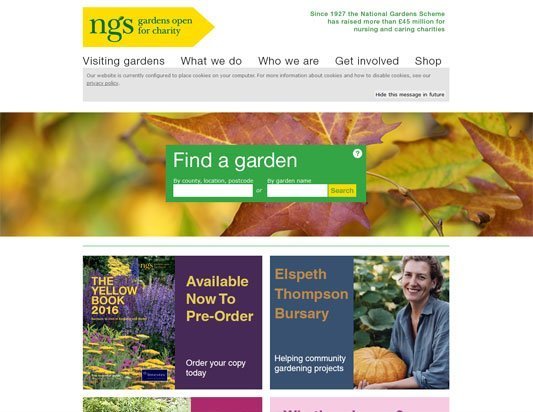
Finally, what better way to generate some gardening inspiration than to get up off the sofa and visit some real-life beautiful gardens? The National Garden Scheme opens gardens – many of them privately-owned – for charity, and it has donated over £45 million to nursing and caring charities since it was founded in the 1920s.
The website is quick and simple to use: you put in your location, and whether you want to visit a garden today, this weekend, within the next 7 or 28 days or on a specific date, and it will tell you which gardens are open to the public. A great way to get gardening ideas and do some good at the same time.
Hopefully this run down of GardenLife Log Cabin‘s seven best gardening websites will arm you with everything you need to enjoy each aspect of your own garden throughout the year.
This website uses cookies and gathers limited anonymous data to improve your experience. Please read our Privacy Policy and opt-out if you wish. Cookie settingsAccept
Privacy & Cookies Policy
Privacy Overview
This website uses cookies to improve your experience while you navigate through the website. Out of these cookies, the cookies that are categorized as necessary are stored on your browser as they are essential for the working of basic functionalities of the website. We also use third-party cookies that help us analyze and understand how you use this website. These cookies will be stored in your browser only with your consent. You also have the option to opt-out of these cookies. But opting out of some of these cookies may have an effect on your browsing experience.
Necessary cookies are absolutely essential for the website to function properly. This category only includes cookies that ensures basic functionalities and security features of the website. These cookies do not store any personal information.
Pin It on Pinterest
GardenLifeLogCabins.co.uk rebrands to Palmako.co.uk
Dear valued clients! For over ten years, you've known us as GardenLife, your trusted provider of Palmako's quality garden timber products in the UK.
Today, we're thrilled to embark on an exciting new chapter together as we introduce our sleek, modern online storefront and transition to Palmako.co.uk!
With over 25 years of experience, Palmako has established itself as a premier producer of quality garden timber products in the UK and Europe, including sustainably sourced Nordic spruce summer houses, log cabins, saunas and more. Our local team of experts is always ready to help you make the best choice for your garden. Learn more: https://palmako.co.uk/pages/about-palmako or call us: 01698 426444.