Promotional offers are often one of the first things users explore when joining a new platform. A Rainbet promo code can provide access to special rewards and introductory benefits, depending on current promotions. Taking the time to understand how these offers work, what conditions apply, and how rewards are distributed can help users get the most value from their experience.
Learning how duelreferralcode.com/ works can help you better understand modern referral systems and how user engagement impacts results. By focusing on consistent sharing and reaching the right audience, you can improve overall performance and build a more effective long-term referral strategy.
Découvrez le jeu Tower Rush Casino en version démo : testez les mécaniques de jeu, explorez les fonctionnalités sans risque et préparez-vous à l’action. Une expérience immersive à essayer gratuitement.
Testez Gratuitement la Démonstration de Tower Rush Casino
Je suis tombé sur ce truc par hasard, pas de promo, pas de hype. Juste un lien qui clignotait sur un forum de streamers du coin. J’ai mis 20 euros, j’ai fait une seule ligne. Rien. Pas un seul symbole qui ressemble à un gain. (Je me dis : c’est un piège ?)
Je continue. 100 spins. Rien. Absolument rien. Pas de free spins, pas de scatter, pas de Wild. Rien. Juste des symboles qui tombent comme des cailloux. Le RTP ? 96,2 %. OK, c’est pas mal. Mais la volatilité ? (C’est un piège à bankroll, c’est sûr.)
Je mets 50 euros. Je perds 45. Je veux voir si le bonus se déclenche. (Sérieusement, il faut combien de spins pour que ça marche ?) Je fais 200 spins en mode base. Rien. Pas un seul retrigger. Le max win affiché ? 5000x. J’ai pas vu ça en 3 heures.
Je me demande si c’est un test. Si c’est une blague. Si le jeu est cassé. Je vérifie les logs. Tout est clean. C’est juste un jeu qui te laisse crever lentement.
Et puis, à la 217e spin, un scatter. Un seul. Et là, le bonus se déclenche. Pas de retrigger. Pas de free spins. Juste un petit tour de 10 spins avec un Wild fixe. Je gagne 30 euros. Je me dis : “C’est tout ?”
Je mets 100 euros. Je perds 92. Je me demande si je suis trop con ou si le jeu est con. Je continue. Je perds encore. Je me dis : “C’est un piège, c’est un piège, c’est un piège.”
Et puis, à la 400e spin, le jackpot. 5000x. Je regarde l’écran. Je cligne des yeux. Je me dis : “Putain, c’est vrai ?”
Je ne recommande pas ce jeu. Pas pour les petits budgets. Pas pour ceux qui veulent du fun. Mais si t’as 500 euros, un cerveau froid, et une patience de chien, peut-être que tu réussis à en tirer quelque chose.
Je le joue encore. Parce que je veux savoir si c’est un coup de chance ou si le jeu a un truc caché. (Je pense que c’est le truc caché.)
Comment accéder au mode d’essai sans créer un compte
Je clique sur le lien direct. Pas de pop-up, pas de formulaire, rien. Juste une fenêtre qui s’ouvre, et hop – le jeu démarre. (C’est rare, mais quand ça arrive, c’est un soulagement.)
Le site utilise un cookie temporaire. Il garde mes paramètres de session. Pas besoin de répéter l’opération à chaque fois. Je fais un petit test de 15 minutes, je mets 5€ de crédit fictif, et je commence à jouer. Pas de vérification d’âge, pas de mail, pas de SMS.
Si tu veux éviter le bordel, cherche un lien qui dit « Jouer sans inscription » ou « Essai instantané ». Les liens avec ?demo=1 ou ?play=now sont souvent les bons. Je vérifie toujours l’URL – si elle contient un paramètre de session, c’est bon signe.
Je mets le volume à fond. Le son du Wild qui tombe ? Parfait. Le bruit du Scatter ? Même si c’est un peu trop fort. (Mais bon, c’est du jeu, pas un concert.)
Le mode d’essai ne te force pas à jouer en continu. Tu fermes la fenêtre, tu reviens demain, et tu reprends exactement là où tu t’es arrêté. Pas besoin de tout recommencer.
Attention aux faux liens
Quelques sites copient le design, mais demandent un compte. Je regarde toujours le nom de domaine. Si c’est un truc bizarre comme casino-essai.fr, je passe mon chemin. Les vrais liens sont sur des noms de domaine connus, ou sur des pages dédiées du site principal.
Si tu veux un test fiable, utilise le lien direct du fournisseur. Par exemple, si c’est un jeu de Pragmatic Play, cherche directement sur leur site. Le bouton « Jouer en mode démo » est souvent en haut à droite. C’est là qu’il faut cliquer.
Quelles fonctionnalités sont disponibles dans la version gratuite
Je l’ai testée sur 48 heures. Pas de bluff, pas de filtre. Tu as accès à l’intégralité du jeu de base. (Pas de pièges, pas de “caché derrière un mur de 1000 spins”.) Tu joues avec 1000 crédits fictifs. Pas de limite de temps. Pas de cap de spins. Tu peux t’arrêter quand tu veux.
Les symboles, les animations, le son – tout est là. Même les effets de transition entre les tours. (Je rigole, mais c’est vrai : ça marche comme en vrai.) Les scatters déclenchent les free spins. Les wilds apparaissent au hasard. Les retrigger ? Oui, ils fonctionnent. J’ai eu 3 retrigger en 20 tours. Pas une fois, pas deux – trois.
Le RTP est affiché à 96,2%. Pas de triche. Le volatilité ? Haute. (Tu peux avoir 20 tours de mort, puis un max win de 500x. C’est le jeu.) Pas de bonus bloqué. Pas de “vous devez débloquer X pour accéder à Y”. Tu veux jouer ? Tu joues.
Le seul truc qui manque ? Les paiements réels. (Ouais, j’ai grogné. Mais c’est une démo. Pas un compte.) Pas de téléchargement. Pas d’inscription. Tu cliques, tu joues. C’est tout.
À retenir
Si tu veux tester la mécanique, le flow, le risque, la réaction des bonus – c’est là. Pas besoin de te lancer dans un dépôt. Pas besoin de te faire arnaquer par un “free spin” qui te coûte 20 euros.
Je t’ai dit tout ce qu’il faut savoir. Maintenant, tu décides si tu veux t’asseoir à la table ou pas.
Comment jouer sans risquer de l’argent réel
Je me suis mis à ce jeu en mode démo, pas par envie de me faire des illusions, mais pour voir si la mécanique tient la route. Pas de perte, pas de pression – juste moi, un écran, et une banque virtuelle de 1000 crédits.
Je commence par lire le taux de retour au joueur (RTP) : 96,3 %. Pas exceptionnel, mais pas une arnaque non plus. Volatilité élevée. (Donc, j’attends des gains rares, mais gros.)
Je mets 10 crédits par ligne, 10 lignes, 100 crédits par tour. Pas de frénésie. Je veux tester la base game, pas me faire vomir en 5 minutes.
Premières 20 spins : rien. Pas un seul scatter. (Même pas un Wild.) Je commence à douter. C’est du vide pur. Mais j’ai vu pire.
À la 23e tentative, j’attrape 3 Scatters. Le bonus démarre. Retrigger possible ? Oui. J’en ai eu 2. Le deuxième a fait monter la mise à 500 crédits. Je gagne 1200. (Pas mal pour un test.)
Je passe à 50 crédits par tour. J’arrive à 3000 crédits. Je décide de stopper. Pas par peur de perdre, mais parce que je vois que le jeu ne veut pas me laisser gagner facilement.
Je note :
– Le mode démo ne simule pas le stress du vrai argent.
– Mais il révèle les vrais défauts : longues séries de dead spins, absence de signes de progression.
– Le bonus est là, mais il faut de la patience. Pas de miracle en 10 minutes.
Ma règle d’or
Si tu veux t’amuser sans risquer un centime, joue 30 minutes par jour. Pas plus. Mise max : 100 crédits. Stop quand tu atteins 1500 ou perds 500. Pas de dérapage.
Paramètre
Valeur
RTP
96,3 %
Volatilité
Élevée
Max Win
5000x
Retrigger
Disponible
Base Game
Longue, sans signes de gain
Le jeu ne ment pas. Il te dit : “Tu vas attendre. Et tu vas perdre. Mais si tu tiens bon, il peut te payer.” C’est tout. Pas de magie. Pas de promesses. Juste du hasard, bien dosé. Et ça, c’est rare.
Les mécaniques de jeu à tester avant de miser
Je me suis mis à 500 tours dans le mode gratuit. Pas pour m’amuser. Pour vérifier si le système tient la route.
RTP à 96,3 % – pas mal, mais pas suffisant si la volatilité est en mode “boulet de canon”. J’ai vu 12 tours sans rien. (12. Sans. Rien.)
Le scatters apparaissent à 1,8 % de chance. C’est bas. Mais quand ils tombent, ils déclenchent un free spins avec retrigger illimité. Attention : le max win est à 5000x. Je l’ai vu en 30 minutes. Pas en 30 heures.
Les wilds ne remplacent pas tout. Ils couvrent seulement les positions 2, 4 et 5. (Pas les 1 et 3. Pourquoi ?)
Le base game est un grincement constant. Pas de bonus à chaque 100 spins. Pas de “nouveauté”. Juste une longue attente.
J’ai mis 200 euros de bankroll en 2 heures. Rien. Puis un free spins de 15 tours avec 4 scatters. Et là, 1200x.
Donc voilà :
Teste les scatters sur 300 tours minimum – pas 50.
Vérifie la fréquence des retrigger. Si tu ne vois pas 2 free spins par 100 tours, oublie le max win.
Ne compte pas sur les wilds pour sauver un mauvais session. Ils ne sont pas omniprésents.
La volatilité est élevée. Si ton bankroll est sous 200 €, tu vas te faire dézinguer.
À retenir
Ce n’est pas un slot pour les débutants. C’est un test de patience. Si tu veux un vrai gain, attends que les scatters tombent en série. Sinon, tu perds ton temps.
Et si tu veux vraiment jouer en réel, ne mets pas plus de 10 % de ton bankroll. Je l’ai fait. J’ai perdu. Mais j’ai vu le 5000x. (Pas en 100 tours. En 487.)
Les avantages de jouer en mode d’essai pour commencer
Je commence toujours par le mode d’essai. Pas par paresse, mais parce que je veux voir si le jeu tient la route avant de brûler mon bankroll.
Le RTP ici, 96,2 %, c’est pas un rêve. Mais ce qui compte, c’est la volatilité : moyenne à haute. C’est du genre à te laisser flotter pendant 150 spins sans rien, puis t’envoyer un scatters qui fait 12x.
Je me suis fait 800x sur une seule session en mode test. Sans mise. Sans pression. Juste moi, le jeu, et une petite victoire qui sonne comme une victoire.
Tu veux savoir ce que j’ai vu en 45 minutes ? 3 retreiggers sur les 20 premiers tours. Le jeu ne te laisse pas moisir. Il te pousse à jouer.
Mais attention : si tu passes directement à la mise, tu risques de te faire surprendre. Le base game est lent. Très lent. Le vrai gain, c’est dans les free spins. Et là, sans tester, tu ne sais pas si le trigger est accessible.
Je ne te dis pas de jouer sans argent. Je te dis de jouer sans stress.
Tu veux voir si le jeu te parle ? Essaie-le. Sans rien perdre. Sans rien gagner. Juste pour sentir le rythme.
Parce que parfois, le meilleur gain, c’est de ne pas jouer du tout.
Comment utiliser la version d’essai pour tester différentes stratégies
Je commence toujours par une mise de 0,10€ par ligne, pas plus. (Je sais, c’est pas glamour, mais ça me fait pas péter le compte en 5 minutes.)
Je mets 100€ de bankroll en jeu, pas 500. Pourquoi ? Parce que si tu veux tester une stratégie, tu dois voir comment elle tient sous pression. Pas sous l’effet de l’excitation du premier gros gain.
Je joue 100 tours en mode base game, sans toucher aux bonus. (Oui, c’est fastidieux. Mais si t’as pas vu 30 retours en 100 tours, ta stratégie de « presser les boutons » est foutue.)
Je note chaque fois que les scatters tombent en position. Pas juste « j’ai eu 3 ». Je note exactement où. Sur les rouleaux 1, 3, 5 ? C’est un signe. Si ça arrive toujours en même endroit, c’est pas du hasard. C’est du design.
Je teste deux approches : une avec mise constante, l’autre en augmentant le pari après chaque perte. (Je veux voir si le système est plus clément avec la martingale ou si ça te broie vite.)
Le vrai test ? Quand tu perds 7 tours d’affilée. Tu restes calme ? Tu changes de stratégie ? Si oui, c’est que t’as une vraie méthode. Si non, tu joues au feeling. Et ça, c’est un piège.
Je ne cherche pas le max win. Je cherche le moment où la machine te rend un peu. Même 2x. C’est là que tu sais si la stratégie fonctionne à long terme.
Si tu as 200 tours sans retrigger, tu arrêtes. Pas parce que t’es frustré. Parce que le jeu te dit : « Tu perds ton temps ici. »
Et si tu gagnes 15 fois en 200 tours ? Tu regardes les stats. Tu vérifies le RTP. Si c’est 96,5 %, mais que t’as eu 15 retours… c’est suspect. (Pas de quoi faire un article, mais assez pour douter.)
Je ne mets jamais plus de 30 minutes par session d’essai. Après, mon cerveau commence à inventer des schémas. Et les schémas, c’est le pire ennemi du joueur.
Le truc que personne ne dit : la vraie stratégie, c’est savoir quand arrêter. Pas quand tu gagnes. Quand tu perds. Et la version d’essai, c’est le seul endroit où tu peux le faire sans risquer un euro.
Le piège à éviter : croire que le bonus est une solution
Les gens pensent : « Si j’attends le bonus, tout va bien. » Non. Le bonus est un piège de durée. Il te fait croire que t’as une chance. Mais si le jeu est conçu pour te faire tourner 500 fois avant de te donner un seul free spin… tu perds du temps. Et de l’argent.
Je vérifie toujours combien de retours en moyenne je reçois par 100 tours. Si c’est moins de 2, je me casse. Pas besoin de longues analyses. Le jeu est contre toi.
Et si tu veux vraiment tester, fais-le en 3 sessions différentes. Même si tu changes juste le pari par ligne. (Parce que oui, le jeu réagit différemment selon la mise.)
Le but ? Pas devenir riche. Mais savoir si tu peux gagner, même un peu, sans te brûler. Et ça, tu le découvres pas en jouant 10 minutes. Tu le découvres en souffrant un peu.
Questions et réponses :
Est-ce que le mode démo de Testez Tower Rush Casino est vraiment gratuit ?
Oui, le mode démo de Testez Tower Rush Casino est entièrement gratuit. Vous pouvez y accéder sans avoir à payer quoi que ce soit ni à vous inscrire avec des informations personnelles. Toutes les fonctionnalités du jeu sont disponibles sans restriction, ce qui vous permet de tester l’expérience complète, y compris les tours, les mécaniques de jeu et les animations, sans aucun coût. C’est une manière simple de découvrir si le jeu vous plaît avant de décider d’investir de l’argent réel.
Est-ce que je peux jouer à Testez Tower Rush Casino sans connexion Internet ?
Non, le jeu nécessite une connexion Internet active pour fonctionner. Il s’agit d’un jeu en ligne qui utilise des serveurs pour gérer les parties, les résultats et les interactions entre utilisateurs. Sans connexion, vous ne pourrez pas lancer la démo ni accéder à son contenu. Cependant, une fois que vous avez lancé la démo sur un appareil connecté, vous pouvez jouer à certaines parties sans interruption si la connexion reste stable, mais le jeu ne peut pas être utilisé hors ligne.
Quels appareils supportent le démo de Testez Tower Rush Casino ?
Le démo de Testez Tower Rush Casino est compatible avec les appareils mobiles et les tablettes fonctionnant sous Android et iOS, ainsi qu’avec les navigateurs web sur ordinateur. Sur mobile, il suffit d’ouvrir le lien dans votre navigateur et de lancer la démo directement. Sur PC ou Mac, vous pouvez y accéder via Chrome, Firefox ou Safari. Le jeu est optimisé pour les écrans tactiles, mais il fonctionne aussi bien avec une souris et un clavier. Il n’est pas nécessaire de télécharger une application spécifique pour jouer.
Est-ce que les gains dans la démo sont réels ?
Non, les gains réalisés dans la démo de Testez Tower Rush Casino ne sont pas réels. Il s’agit d’un jeu de simulation qui utilise des crédits virtuels. Ces crédits ne peuvent pas être retirés ni convertis en argent réel. Le but de la démo est de vous permettre de vous familiariser avec les règles, les mécaniques et l’ambiance du jeu sans risque financier. Si vous souhaitez jouer avec de l’argent réel, vous devrez passer à la version payante ou créer un compte avec des fonds réels.
Combien de temps dure la démo de Testez Tower Rush Casino ?
La démo de Testez Tower Rush Casino n’a pas de limite de temps. Vous pouvez y jouer aussi longtemps que vous le souhaitez, sans interruption. Il n’y a pas de compte à rebours, ni de restriction sur le nombre de parties que vous pouvez faire. Vous pouvez revenir à tout moment pour continuer votre session ou recommencer depuis le début. Cette liberté permet de tester le jeu dans toutes ses dimensions, sans contrainte temporelle.
Est-ce que le mode démo de Testez Tower Rush Casino est disponible sans téléchargement ?
Le mode démo de Testez Tower Rush Casino peut être joué directement dans le navigateur web, sans nécessiter de téléchargement ni d’installation. Vous pouvez accéder au jeu dès que vous ouvrez la page officielle, ce qui permet de tester rapidement les mécaniques, les graphismes et l’ambiance du jeu. Il n’est pas nécessaire de créer un compte pour commencer à jouer, bien que certaines fonctionnalités puissent être limitées sans connexion. Cette version accessible immédiatement est idéale pour ceux qui souhaitent découvrir le jeu sans engagement ni perte de temps.
Don’t wait. If the game freezes mid-spin, don’t relog. Hit chat. Say “Game crashed on spin 37.” That’s enough. They’ll pull your session logs. I’ve seen it happen. (It’s not magic. It’s just a team that knows their backend.) Genre isn’t just theme. It’s mechanics. A “pirate” slot from Pragmatic might have 50 free spins with retrigger. One from a lesser-known studio? 10 spins, no retrigger, and a 93.5% RTP. That’s not a game. That’s a trap.
And never trust “instant” withdrawals unless it’s crypto. Even then, check the blockchain confirmation time. If it says “instant” but takes 30 minutes to show in your wallet, kuki muki they’re bullshitting you. Pro Tip: Use a prepaid card if you’re nervous about charges They’ll take it. I used a $200 prepaid Visa. No issues. No “we can’t verify.” Just a swipe. The system doesn’t care if it’s not linked to a bank. It’s not a bank.
It’s a room. Use real money, not demo. Not a demo. I put $20 into the game. If the mobile version crashes mid-retrigger, I’m not coming back. Not for the max win. Not for the free spins. Not for the 100x multiplier. How a Realistic Lead Shaped the Film’s Edge and Emotional Weight I walked into the theater expecting another slick spy romp. Instead, I got something raw. The actor’s physicality–lean, tense, not polished–hit different.
No smooth walk, no effortless charm. Just a man carrying weight. (Like my bankroll after a bad session.) Are Christmas casino events suitable for families? Yes, many Christmas casino events are designed with family participation in mind. While some areas may have games with betting elements, there are usually dedicated zones for children and non-gambling activities. These include craft stations where kids make holiday decorations, cookie decorating, or storytime with Santa. Food and drinks are often family-friendly, with hot cocoa, apple cider, and festive snacks.
The atmosphere is generally cheerful and inclusive, making it a good option for gatherings that include people of all ages. How to Use Mobile Compatibility to Test Game Performance I fire up the app on my iPhone 14 Pro, tap the game, and let it run for 12 minutes straight. No excuses. If it stutters during the bonus round, I’m out. Not a fan of fake “smooth” claims. Live chat response under 45 seconds? Rare. But if it’s under 30?
That’s a sign they’re not outsourcing to some 3 AM shift in Manila. First reply in 15 minutes? Okay. But if the second reply takes 4 hours? That’s a red flag. I’ve seen agents ghost after “We’re looking into it.” Use the ticket system. Send a message at 11 PM. Check back at 8 AM. If no update? They’re not monitoring it.
Our top summer house colour schemes with real customer photos
Asking “what colour should I paint my summer house?” – Here are our ideas
Choosing the right colour to paint your much loved summer house can be problematic. The last thing you want to do is pay out a small fortune on paint, spend half a day studiously decorating, and then discover your choice of colours doesn’t work. The wrong shade of green could make your summer house disappear into the surrounding plants. Pick a bright colour to help it stand out, get the wrong shade, and you could end up with an eyesore.
To help you pick the best summer house paint colours we’ve selected photos showing real customer summer houses in a range of different colours.
1. Why paint your summer house?
There’s a practical element to painting a summer house or any other timber garden building: it gives protection from the weather, insects, mould and fungus. Even if you opt for a dip treated summer house, we recommend that all our timber buildings are finished with paint or varnish as soon as they are constructed.
But practicality is just the start of it. You can use the colour scheme of your summer house, shed or garden room to say something about yourself, complement certain aspects of your garden, help the building blend into the background or make it a focal point of your garden design.
2. Choosing a summer house paint colours
A dash of paint can be the difference between a traditional English-style summer house and a contemporary garden office. It can conjure up the beach, a Nordic forest, the Scottish Highlands, some urban cool, or leave the eye free to focus on the plants around it.
And for those who already own a summer house, a paint job is a relatively hassle-free way to transform or revive an ageing garden building.
Obviously, that’s empowering; it’s also a bit daunting. Given the power of colour to transform, where on earth do you start?
3. A few basics about choosing a paint colour for a summer house
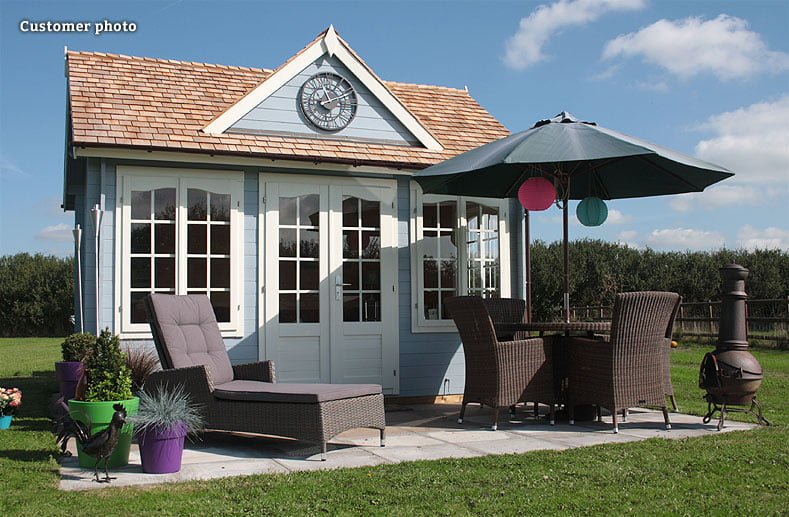
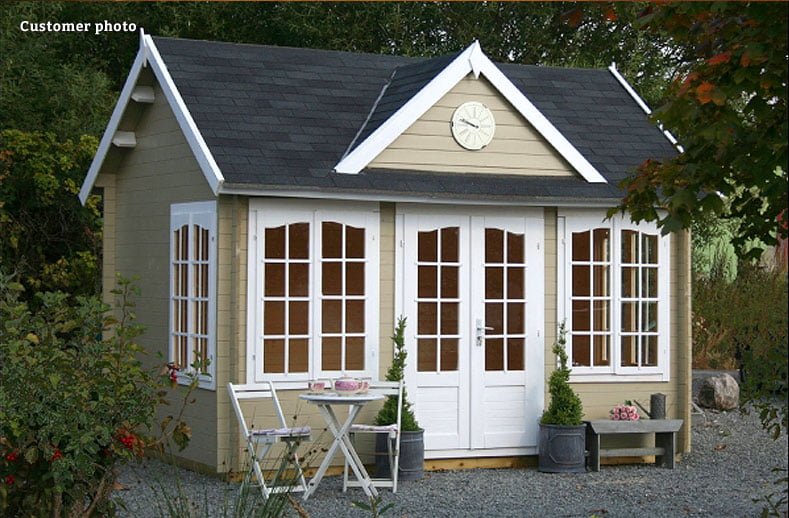
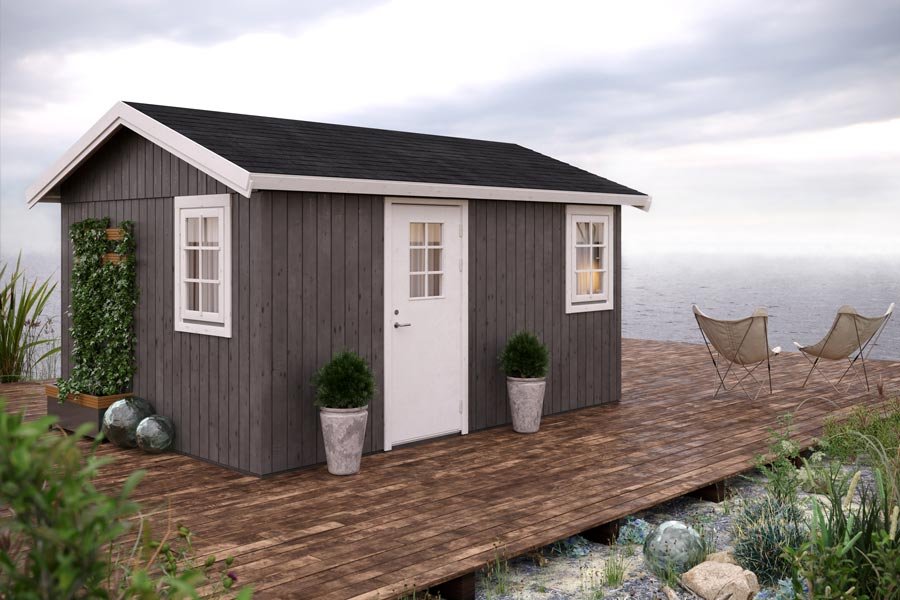
The ‘classic’ summer house paint scheme is to have the walls in a darker shade, and the doors and windows a lighter shade – white, cream, or a paler shade of the wall colour.
Greens, beiges and greys work well with this format, as do a wide variety of styles and sizes of building. A great example is the beige and crisp white scheme one of our customers used on a traditional clockhouse garden building, which has been nicely enhanced with garden furniture and topiary.
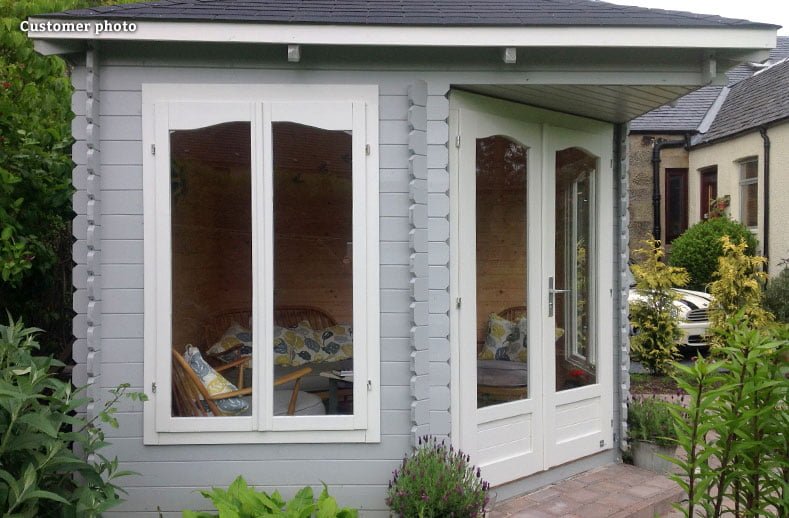
For a darker colour scheme, look at the dark/light combination on this Melanie corner summer house. The olive-green walls help it blend with rest of the garden, whilst the blue plant pots add a dash of colour.
4. Bold and bright Summer house paint colours
The darker walls / lighter trim approach works well with bolder colours too. You’re making more of a statement, but still not breaking any rules. Blue and white gives a good nautical or vintage feel, and colour contrast also helps to highlight the excellent design, build and features of a summer house. Take a look at:
We love both these shades of blue, which give a Mediterranean feel in summertime, and inject some cheer in the autumn and winter months, without looking out of place against greyer skies. See how a blue roof can add to the effect.
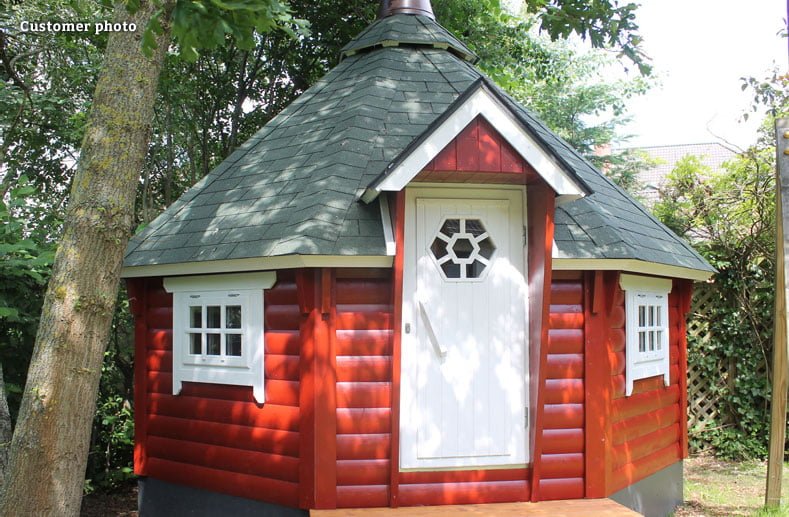
Another popular colour with our customers is dark red or burgundy. Take a look at these two beauties, both with a distinct Nordic style – one looks like an enviable island summer house, the other is straight out of an enchanted forest. In both cases, the lighter doors and windows add definition.
5. Use just one summer house paint colour
Another option is to use the same colour throughout and it’s interesting to see the different effects this can achieve. Generally, a single colour makes a summer house merge with its surroundings more – though of course it depends on the colour. Pink walls and window frames certainly don’t disappear into the background – however vibrant your garden.
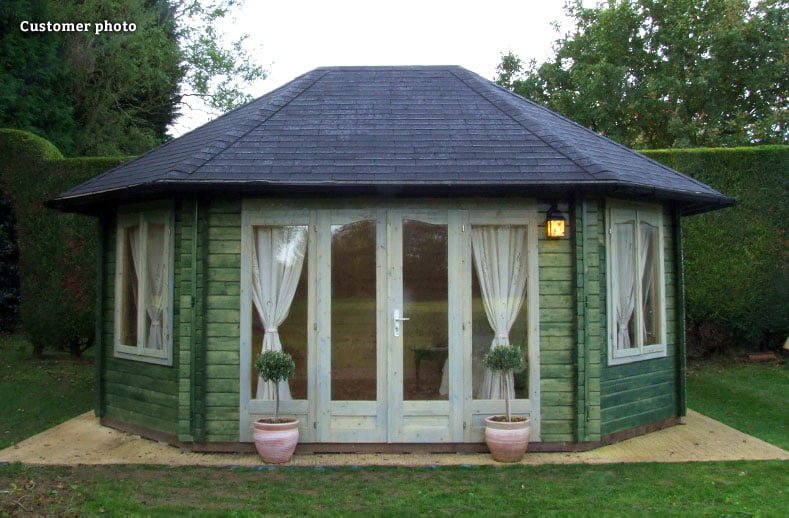
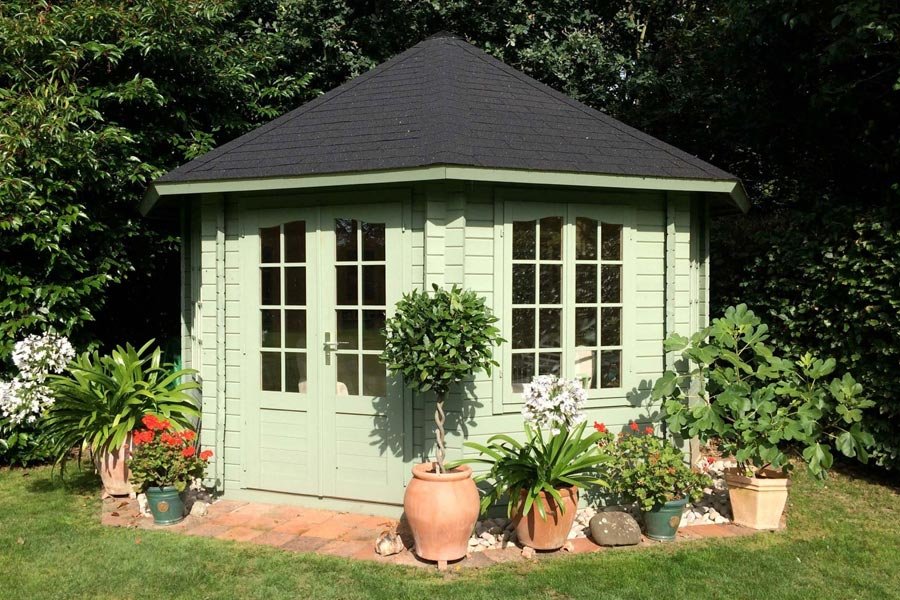
This octagonal Hanna summer house has been painted an attractive pale green which blends with the surrounding garden – it’s certainly not camouflaged or invisible, but it’s not saying ‘Admire my fine door and window features!’ either.
6. Using neutral summer house paint colours
You can take this blending effect a step further with neutral colours, and we particularly like two customer examples of this. First is a modern, white garden room that pulls your eye towards the horizon and lengthens the garden. Lighting inside and out adds warmth to the stripped-down design, and we would happily spend many a day there.
We would also happily while away the summer in this Veronica pavilion and the beautiful garden that surrounds it. With a natural dark wood stain throughout, the structure almost disappears into the surrounding garden. Windows on all sides of the summer house mean the garden is visible from every angle.
7. Stain or paint a summer house with colour?
This brings us onto another basic ‘rule’ about colour – that using stain rather than paint allows the natural grain of the wood to show through. And stain doesn’t have to be brown. Using a pale limewash-effect stain can give a vintage feel, or you could go bolder in your colour choices, as with this Hanna summer house.
Using a stain makes the colour less ‘in-your’ face than paint, and more rustic – not so great if you were looking for a more urban effect.
8. Summer house paint colours for modern living
If you’re after a more modern or urban feel for your summer house paint colour choice, matte paint is a good bet. Greys, black, charcoal, or the dark, dark greens and midnight blues that you see on front doors in Amsterdam make a good colour palette here.
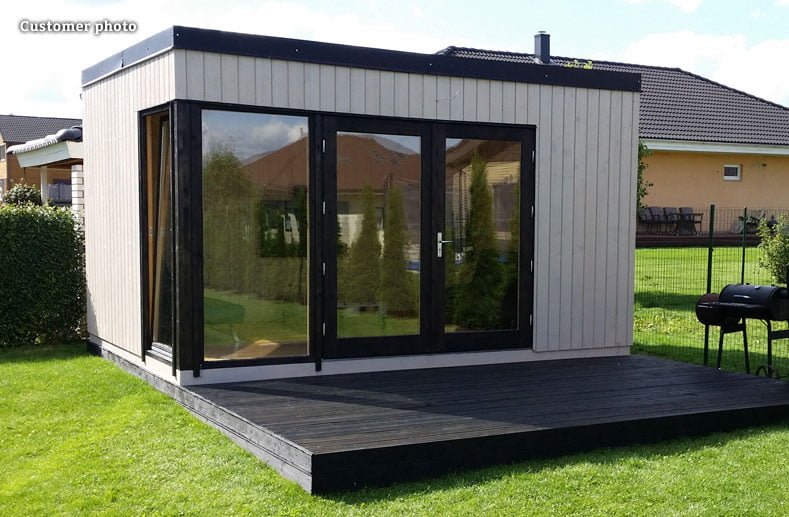
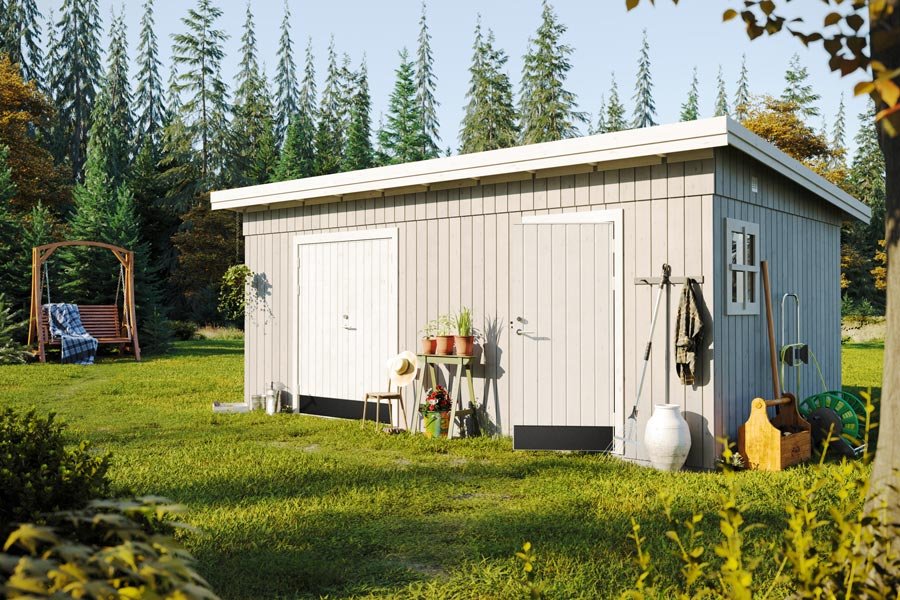
These colours make even a traditional summer house look more twenty-first century, and work very on contemporary designs too. A contrasting white or grey trim will catch the eye, as can a reversal of the usual dark/light principle – so you have pale walls and darker doors and/or windows.
9. Adding summer house colour through accessories
Finally, a word about accessories and touches of colour. Borrow a great tip from many a boutique hotel, and use a grey palette (or other neutrals) for walls, floors and doors and add touches of bright colour (eg inspired by flowers and other plants) for anything from cushions to garden furniture to plant pots.
10. Keep things flexible
As well as adding sophistication to the overall look, the ‘boutique hotel’ approach is practical – you can keep the neutral backdrop to your summer house unchanged, and change the accessories to alter the look. A pale-grey Japanese-inspired garden room with minimal decoration could transform into a seaside theme with the addition of some blues, and stripes and different furniture.
Sustainable garden design – 15 quick and essential tips
It’s odd to think that a garden may not be an environmentally-friendly or natural place. Most have a lawn, greenery and some trees. However, these days it is often normal for paving slabs, non-native species, fences and chemical sprays to prevail. Together, these can all make for a rather hostile and unsustainable habitat that is far from natural.
Creating a sustainable garden design that’s healthy, supportive of nature, an ethical food source, and that is also good for the environment and climate doesn’t have to be a huge commitment however. There are lots of simple steps you can take, and they don’t require expensive kit, specialist environmental knowledge, or a lot of time.
Here are 15 quick steps toward a sustainable garden design that will allow you to turn your lot into a rewarding food source, a haven for indigenous species and an ally of the wider environment and climate.
1. Encourage native trees
Unsurprisingly, native garden wildlife prefers and benefits from indigenous tree species, which means more biodiversity and healthier wildlife in your garden. Native trees such as Alder increase nitrogen levels in the soil, and nitrogen helps other plants grow. Downy Birch and Silver Birch both draw up nutrients from deep within the soil, again, benefitting other nearby plants. You can read more about the benefits of indigenous species on our blog post about planting native British trees. When it comes to a sustainable garden design, you can’t beat native trees that support wildlife and feed and nourish other plants in the garden.
2. Grow a native hedge
Instead of installing a fence or building a wall, what about planting a native hedge instead? A hedge may not provide instant security or privacy, but it will provide pollen, food, shelter and a home for moths, butterflies, spiders, insects, birds and hedgehogs (and with hedgehog numbers in steep decline, a native hedge could make a difference). Building a fence consumes natural resources and can lock out native wildlife. However, a healthy growing hedge helps to capture and store carbon dioxide (which can help fight climate change). A mix of field maple, beech, hawthorn, blackthorn, elder, dog rose, hazel, holly and crab-apple is ideal, but if you do opt for a fence, consider a hedgehog hole.
3. Make a log pile
If you can’t source sustainable logs locally, buy a sack at the local garage, drill some holes in the ends with a 5mm drill bit, and make a small pile in the garden ensuring that the holes catch the morning light. This little log pile will provide a home for numerous insects, beetles, bugs and bees, all of which will help with pollination (and with bee numbers declining rapidly they need all the help they can get). In time the log pile will rot down and the nutrients it releases will benefit other nearby plants.
4. Create a veg patch
The most obvious element of sustainable garden design is a veg patch. It’s incredibly rewarding to cook with your own homegrown food, and growing it doesn’t have to be complicated. Peas, broad beans, purple-sprouting broccoli, beetroot, salad leaves – they’re just some of the great veg you can grow easily in your garden, and they taste so much better than shop-bought versions. You’ll also cut down on pollution and carbon dioxide from food miles that supermarket veg stack up in order to reach your plate. If you don’t have much room that’s not a problem either. To grow your own potatoes all you need is a sack full of soil, you can train peas and beans to grow up around existing trees, and garlic and spring onions will grow in tubs.
5. The same goes for fruit gardens
Even the UK’s unreliable climate produces everything from apples and pears to cherries, blackcurrants, strawberries and rhubarb, and you don’t have to have a huge garden. Pollinators flock to fruit trees and bushes, and if you’ve ever tasted a raspberry or bramble straight off the bush you’ll know there’s something about it that plastic-wrapped fruit just can’t replicate. When you eat seasonal fruit that you’ve grown yourself you are helping to reduce pollution, carbon dioxide and packaging waste. When planning a sustainable garden design, a mix of fruit trees and native trees is a must.
6. Grow salad and herbs in containers
Lack of space, or even a garden, doesn’t have to stand in your way of growing your own. Herbs and mixed salad leaves can thrive in a window box, or if you have space but no soil, a small raised bed. They’ll taste great, and you’ll be saving on food miles. You could also integrate vertical vegetable gardening as part of a sustainable garden design.
7. Make your own compost
All it takes is a bin, and those scraps of food, lawn clippings and garden waste that you would otherwise throw away. The bins themselves are extremely cheap – or you could DIY it with an wooden pallet. Composting will give you a sustainable and nutrient-rich source of soil without having to buy in chemicals or peat-based compost. You’ll save money as well as recycling your waste into a highly useful product.
8. A weed is a flower growing in the wrong place
This may require a mental U-turn for many gardeners. Allowing native grasses, flowers and other plants referred to as “weeds” to flourish could greatly improve your garden, help the wider environment and local wildlife. Native species will attract plenty of pollinators, which could also be helpful for flowers, fruit trees and other plants in your garden. Species such as clover and vetch are often eradicated from lawns and beds, but they are both nitrogen fixers, enriching the soil to the benefit of plants around them. Even if you don’t want weeds growing throughout your garden, setting aside a space for a wildflower patch would be highly beneficial. As with alder and birch trees, having vetch and clover improving the soil is an important part of any sustainable garden design.
9. Spurn the chemicals
Pesticides, weedkillers and solvent/oil-based timber treatments can all make your garden hostile territory for wildlife. With oil being a major ingredient in both the products and manufacturing process they aren’t sustainable either. Chemical traces can linger in soil and water sources for years to come too. Opting for alternatives like organic pesticides or natural herbicides will still get rid of unwanted bugs and weeds without warding off the nice ones. Simpy deadheading weeds before they flower is often a highly effective solution.
10. Look for organic fertilisers
Feeding your garden plants is important to help keep them healthy and strong, but the production and use of chemical fertilisers has a high environmental cost (in resource use, shipping and waste). Chemical fertilisers can also flood water systems with excess nitrogen, which can lead to numerous other environmental problems far afield, such as algal blooms. Instead, for your sustainable garden design consider pine needles and pine wood chip to help enrich acidic soils that ericaceous plants such as rhododendrons and azaleas need. Use wood ash (from a wood burning stove), liquid seaweed solutions (available from most good garden centres), home made compost, and cow manure or horse dung (if you can get them locally) to feed and support plants and naturally improve poor soils.
11. Collect rainwater
Our climate is changing. In the UK we’re seeing more intense downpours and longer, hotter dry spells. If you opt to collect free rain water you’ll avoid paying the financial and environmental cost of getting water from the tap. It’s also worth noting that rainwater is generally better for your plants than chemically-treated tap water. We’ve already got a handy article about using water butts to collect rainwater here. Rainwater collection really is an essential element of sustainable garden design.
12. Help to avoid flooding
With storms and extreme rain becoming more frequent, we can all to do our bit to deal with run-off water. Do whatever you can to avoid paving over your garden, or using paving slabs for patios and garden paths – instead look at alternatives such as woodchip or gravel. If you collect rainwater in butts (above) and allow your garden to soak up heavy downpours, you can reduce runoff and the chances of local flooding.
13. Dig a pond (or make a small rain garden)
Yes, this can seem like quite an undertaking, but in a past blog post we outlined some really straightforward ways to create a pond in your own back garden. You’ll create the perfect habitat for frogs, toads and newts, especially if you dig one with shallow edges for them to slip in and out (avoiding steep sides also reduces the risks of small mammals such as hedgehogs falling in and drowning). Dragonflies and water beetles can usually be spotted after just a few weeks, and birds will use it for drinking.
14. Provide water sources for other wildlife too
Birds and animals need to drink, and in a long hot summer that can be a problem. Bird baths are an easy option, and you don’t necessarily have to go the whole hog with a stone bath – you could just fill a plant pot with water. Meanwhile, a small bowl of water, kept topped up, can attract hedgehogs and keep them around over the summer. There are other tips on making your garden hedgehog-friendly, and since hedgehogs help keep down slugs, they’re definitely a gardener’s friend.
15. Build a bee-hotel
Don’t be deceived by the name – these are easy to build, as you can see in this guide. They’ll support bees (especially solitary ones) which in turn will increase pollination in your garden. All of which means, more beautiful and healthy flowers – not just for you, but all the other gardens in your area!
If you look at the above list, panic, and wonder where to start on your sustainable garden design, don’t worry. You can transition your garden to a more natural wildlife-friendly habitat over time.
Have you noticed how people are talking about gardening, therapy and mental health recently? ‘Horticulture therapy’, as some people call it, is an increasingly popular prescription for everything from depression and anxiety to loneliness and lack of purpose.
In one recent survey, four out of five people said gardening has a better impact on mental health than hitting the gym. The Metro newspaper quoted a psychotherapist saying, ‘Gardening is a brilliant de-stressor. Hacking down shrubs, mowing the lawn, digging in bulbs, even just weeding and planting can lower blood pressure and create a healthy mindful state.’
According to the report, the combination of fresh air, exercise, natural light and Vitamin D can help fend off depression and low moods.
Gardening; therapy for modern life
You don’t just have to take Metro’s word for it. There’s a growing (no pun intended) number of organisations using gardening and farming to help people with disabilities, health or mental issues.
There’s Thrive, for example, a charity that ‘uses gardening to change lives’. It helps people with disabilities or mental health issues to garden, and it runs a wonderfully practical website with tips on gardening after a stroke, in a wheelchair, with one arm, or other conditions. It has a nice leaflet you can download giving advice on using gardening to improve your emotional wellbeing. It’s called Gardening: The feel good factor.
Meanwhile, the Royal Horticultural Society (RHS) is funding a pilot scheme for GPs to refer patients with a variety of ailments to ‘therapy gardens’ – there’s an interesting article about it here.
But you don’t have to be clinically depressed or ravaged by stress to get the benefits of horticulture – anyone can give themselves a wellbeing boost by getting out the gardening gloves. In fact, when it comes to gardening, therapy and mental health, you don’t even need your own garden!
No garden, no problem
When you think about what gardening actually is, it’s really not surprising that it’s a powerful destressing mechanism. As long as you leave your mobile behind, being outside, surrounded by nature, away from the pressure of the office and free from nagging email inboxes and notifications, what better setting to relieve tension and promote calm in our hectic lives?
If you aren’t lucky enough to have your own garden, then spending some downtime in a city park or strolling out of town through fields or woods can be just as effective.
Scientists have actually found that as humans, we instinctively relax when we’re in a natural setting – one Stanford University study found spending time outdoors decreased activity in areas of the brain responsible for depression and negative emotions, as well as lowering levels of stress hormones. It’s in our DNA: we like to be outdoors, and when we are, our bodies and minds thank us for it.
Breaking a sweat to beat the blues
When considering gardening, therapy and mental health, it’s worth considering getting active outdoors. While perhaps not akin to Olympic weightlifting or marathon running, gardening certainly counts as exercise. You can burn almost 400 calories from an hour of lawn-mowing, according to Saga.
Just like running or weightlifting, gardening releases the feel-good hormones known as endorphins, along with a whole host of others including the so-called ‘happy chemical’ serotonin. Regular endorphin release has been shown to reduce stress and anxiety and improve sleep and even self-esteem.
And, there’s one benefit that running and weightlifting certainly can’t offer – if you use your garden to grow some fruit and veg, you’ll get a further health boost from all the vitamins and other nutrients they’ll bring to your diet. You don’t get that from 10 minutes on the treadmill.
How to reap the rewards
You don’t have to be gardening to relax or destress, but it does give you an incentive to spend time outdoors, keep moving and do something life-affirming.
Apparently, designing your garden to be a ‘myriad of greens’, rather than a riot of colour, is particularly restorative. And having a design that forces you to move slowly – with winding paths and stepping stones etc – is also suggested to be therapeutic and an aid to mental health. It’s based on the mindfulness concept.
On the other hand, you may prefer bright colours and geometric patterns – we each have own feel-good preferences.
You could also think about creating a separate ‘you’ space in your patch, such as a summer house or other garden building, which can create a peaceful sanctuary – a safe space, if you will, that adds a layer of protection between you and the worries of your daily life.
At some point, most of us will be hit by feelings of isolation or loneliness – it seems like a 21st-century pandemic. This too is something gardening therapy can help with.
Many of us garden alone, but social gardening is also very much a thing. It’s a great way to connect with people you wouldn’t otherwise have met, alongside reaping all the health benefits we’ve already covered.
Thanks to organisations like Farm Garden, you should be able to find gardening groups and initiatives in your local area. The RHS also has some good community gardening webpages, where you can find local groups or get ideas for setting one up. Groundwork is another great example of a nationwide community gardening initiative.
Gardening with a goal
As humans, we seem to be hardwired to work towards a goal, and gardening gives us one – be it a grand flower garden worthy of the Chelsea Flower Show, a community project or just a mini herb garden in a couple of window boxes.
Of course, when considering the crossover of gardening, therapy and mental health, gardening alone isn’t an instant cure-all for modern life’s ills. The process of creating a garden is a slow one, and plants don’t always thrive like you want them to. But the commitment you put in is always well-rewarded – not necessarily with a bumper crop of carrots, with a sense of purpose, a stake in the future, and something to care for. Doesn’t that sound like just what the doctor ordered?
Cheap or quality? Pop-up or permanent? Metal or timber?
Thinking of buying a garden gazebo in the UK? If you live somewhere windy, where rain regularly comes at you diagonally, a wooden garden gazebo may not be for you. But if you live anywhere else, it could be your ideal solution for garden living.
The Americans love gazebos because they provide shade from the sun. In the UK, we love them because they shelter us from rain as well.
They also offer a degree of privacy, without you having to go the whole hog and buy a summer house. That’s why gazebos are so popular for garden hot tubs and barbecues. But we’re getting ahead of ourselves here. First, let’s go back to basics and say what they actually are.
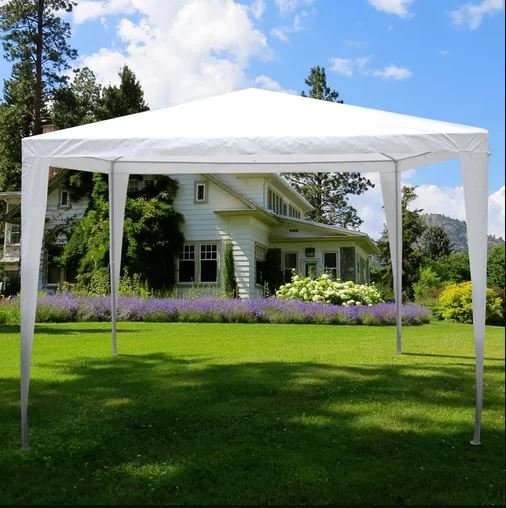
The short answer is that a gazebo is an open-sided garden structure with a roof – a pavilion or summer house without walls. If you want to know the precise difference between gazebos, pergolas, pavilions and the like, there are more detailed descriptions on The Spruce website. But to our minds, there are more important questions to think about:
How can a gazebo help you get more from your garden?
How should you go about choosing a garden gazebo?
Gazebos and garden living
So, let’s look at the first question, how could a gazebo help you get more from your garden. We’ve already said a gazebo could protect you against sun, rain, and curious eyes. You could use it to do yoga, lounge with a good book, shelter a barbecue, sitting or dining area, or provide a covered play area for the kids (that’s if the hot tub has not got there first).
In other words, it can turn your garden into an extra living space.
A gazebo can also be a focal point for a garden design – the eye is drawn towards it, but the open sides allow you to see beyond to the rest of the garden as well.
How to choose a gazebo for the weather in the UK
Old-fashioned gazebos were permanent structures, built of wood, brick and/or cast iron. But that all changed with the advent of the ‘party gazebo’ – lightweight, pop-up gazebos that are now a staple of parties, school sports days, fun runs and anything else that takes place in the open air in the British Isles.
Prices for these start from about £20, though that will likely get you something flimsy that won’t survive more than a gust of wind that’s typical in a UK summer.
There are also more upmarket and robust versions of the temporary gazebo, with design styles modelled on marquees, safari camps or vintage garden fetes. These tend to cost from £100 upwards, depending on size and sturdiness.
Then you get semi-permanent models – with sturdy aluminium, steel or cast iron supports, and available in contemporary designs as well as traditional. These work well on patios as well as lawns, and may run into hundreds of pounds.
What if you want something more robust and longer-lasting, a gazebo that won’t blow away or buckle if the wind blows?
If you really want permanence, you’ll be looking at bricks and cast iron – like a Victorian bandstand. More feasible for most of us, though, is a high-quality timber gazebo, built to withstand the damp English, Scottish or Welsh climate. Below we look at a few of the factors to think about when buying a garden gazebo.
What you’re going to use it for: do you want a completely flexible open space, where you can sit with deckchair or book one day, or lay out a table of party food another day? Or do you want it as a shelter for a hot tub? If you’re planning a hot tub, GardenLife sell a gazebo with a back wall that provides extra privacy and shelter from the wind.
Whether you want a floor: the answer to the above will help you decide this; so will your budget. On some models, the floor comes as optional, so you’re free to decide which would suit your plans and price range.
How much space you want: you’ll want to balance flexibility vs aesthetics vs budget. And you don’t want too big a structure to over-dominate a garden. And your kids won’t thank you if you ruin their back-garden football games with a gazebo plonked in the middle of the lawn (though technically the open sides mean it shouldn’t stand in the way of a curling free kick).
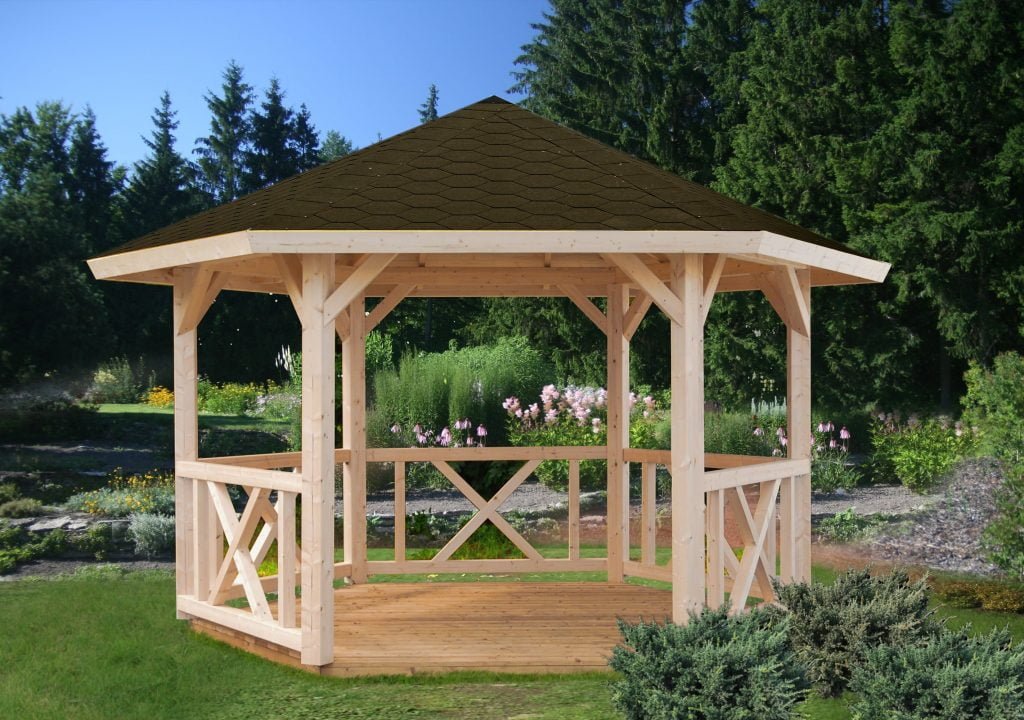
The best shape for your garden: a simple four-sided gazebo is cost-effective and practical but it can look quite plain and functional. A hexagonal gazebo or octagonal shape will look softer and make an attractive centrepoint. If you take a look at GardenLife’s Betty gazebo, you’ll see for yourself how the same design takes on a very different character depending on which shape you go for.
Traditional vs contemporary: the usual advice is that the gazebo should reflect the style of your home – so a period home gets a period-style gazebo. But don’t feel trapped by that – you could set up a good contrast in the same way that a contemporary bathroom style can work well in a period home. However, it’s still a good idea to have colour and roof shape blend with the house or other garden buildings. You’re looking for a centrepiece not an eyesore.
Whatever style you choose, you’ll want it to be as low maintenance as possible. On a timber model, that means looking out for:
slow-grown timber; this has a denser grain than fast-grown timber, so the gazebo will be sturdier and less likely to warp
laminated timber support posts – lamination helps protect against damp, and the warping and swelling it can cause
pressure-treated flooring that’s resistant against rot and decay.
When it comes to buying a garden gazebo in the UK, touches like these can make all the difference in terms of finding a durable, long-lasting gazebo that can withstand British winters.
Our advice on why you need a water butt, and which water butt to choose
We live in a mild, rainy climate in Britain, so water shortages are not really high on our radar. But as recent summers and unseasonal dry spells have proved, hosepipe bans and the need to conserve water are likely to become more of a thing.
So, we’d all do well to think how to keep our gardens green without just turning on the taps.
The answer is a good old-fashioned one – a garden water butt connected to the guttering of your house, garden room or shed. Even without the prospect of hosepipe bans, they’re a good idea for anyone with a garden:
If you’ve got a water meter, a garden water butt will save you money
Water butts are good for the environment – even in a country where water is plentiful, the processes involved in getting clean water to our taps use a lot of energy resources
Your plants will thank you – rainwater is free from chlorine and treating agents found in tap water
But with some garden water butts stretching into £1000-plus territory, your wallet won’t necessarily thank you if you make a rash purchase. So, when it comes to choosing the best garden water butt, here’s our guide to making an informed and cost effective decision.
Your rainwater butt options
There’s a huge range to choose from when it comes to picking the right rainwater butt. Water capacities can range from 100 to 1000+ litres, and even more with some multi-tank systems. You can choose from simple plastic garden water butts to terracotta designs with fancy brass taps and built-in planters. Here’s a look at some of your choices for the best garden water butts.
Cheap garden water butts
Your cheapest and simplest option is going to be a plastic barrel-style garden water butt. For £25 to £40, you’ll get a durable tank with roughly 200-litre capacity and a built-in plastic tap. They’re not especially pretty, but they’ll get the job done just fine.
Garden centres and DIY shops sell a good choice of rainwater butts, and some councils sell a limited range too. You’ll also find some good examples of budget-friendly water butts online at Evengreener.com and B&Q.
Things you may want to check, even if your budget is very tight, include whether:
the plastic is recycled
there is a child-proof lid
the tap is sturdy – the last thing you want is a flimsy, ill-fitted tap that lets the water leak out
If city-living has left you with a small plot and you’re tight on space, there are plenty of slimline water butts with unobtrusive designs. They’ll fit well into tight corners or restricted spaces, albeit at the cost of having smaller capacity. You’ll find some of the best garden water butts with a slimline design at Water Butts Direct and Homebase.
Rustic garden water butts
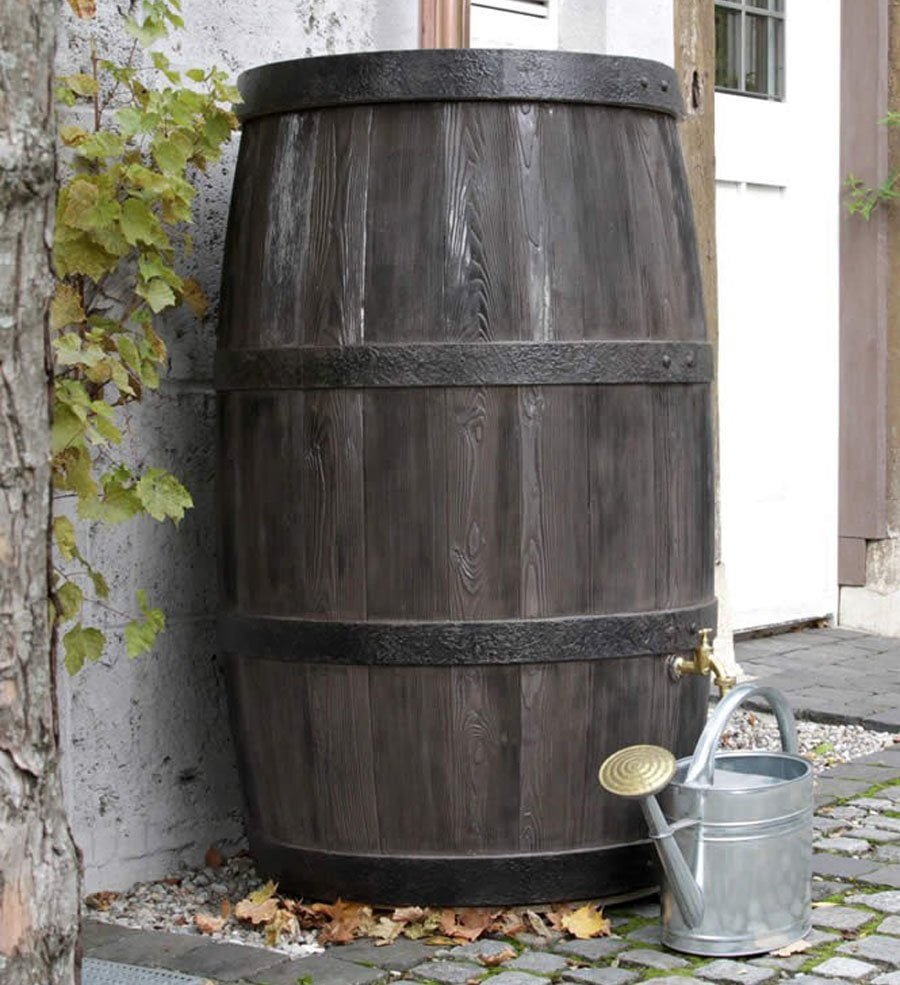
A plastic rainwater butt may look out of place by an old country cottage or in a rustic-style garden design. But don’t worry – a wooden (or ‘wood-effect’) water butt will blend in nicely. Smaller oak barrel style designs or huge 500-litre tanks are both functional and elegant.
You can even find garden water butts disguised as tree trunks. However, if you do want a water tank that looks like a sawn-off tree, expect to pay more – certainly upwards of £75, going all the way up to the hundreds.
Getting fancier – stone and terracotta water butts
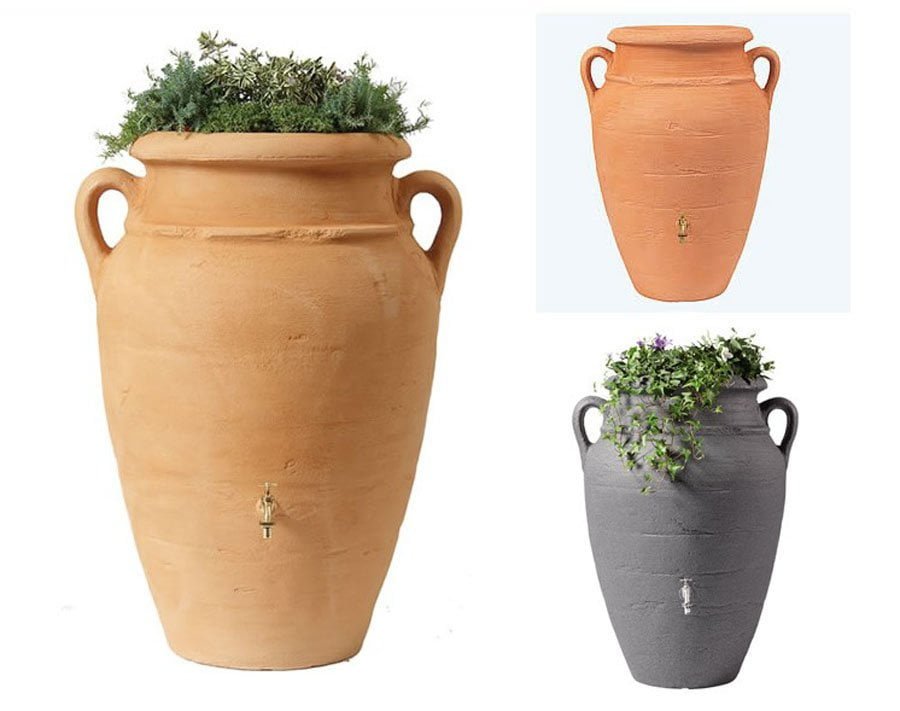
Here you were, thinking you’d never describe a garden water butt as classy – especially after looking at the fake tree trunk versions. Some of the best garden water butts have an antique-style or stone effect look, with a choice including terracotta, granite, sandstone – many with a distinctly Mediterranean style.
You’ll find tasteful brass taps galore, vase and amphora styles, and the option to have planters and bird baths on top of the butt. Prices can be hefty, and you’ll need to watch out for the cost of extras like downpipes and fittings (see the section below on installing a garden water butt). But they can be a distinctive or complementary part of a garden design, in which case the cost will be worth it.
Multi-tank garden water butts
Blessed (or cursed) with a huge plot? If you go through lots of water or just fancy the peace of mind from having more storage, single garden water butts are no match for multi-tank systems. You have a choice here of hundreds or thousands of litres capacity. And you don’t have to spend a fortune.
With any garden water butt, big or small, plastic or rustic, you need to work out how you’re going to gather rainwater.
Some smaller butts collect water by having no lid, but these are far from ideal as their surface area is not enough to gather a significant amount of rainfall (and the open lid allows for water loss by evaporation). Instead, most water butts attach to the downpipe from your gutters (be it home, summer house or shed) and gather the rainfall that the whole roof collects. Even a small 2m x 2m roof can collect over 3000 litres a year with average UK rainfall.
The best garden water butts come with a kit for you to connect the tank to the pipe. However, there could be complications. Most will work only for certain sizes of downpipe, and not for cast iron ones, so you may need to buy a different connector kit. You may also want to look at diverter kits, which take away excess water.
Filling up buckets or watering cans from a tap a few inches from the ground can range from tricky to impossible. The best garden water butts come with stands included, but with others it will be an optional extra, to be factored into your cost calculations.
There are also universal stands, but it’s still important to double-check if the stand is compatible with your tank size and weight.
Garden water butt maintenance
Keeping your water butt well covered will help to stop debris falling in, and reduce slime and algae forming. It will also avoid the water being used as a breeding ground for mosquitoes.
The best garden water butts come with secure lids, but even then you need to prevent algae and slime, so a splash of non-toxic rainwater treatment a few times a year will keep your water nice and clean.
There is a small risk of nasty Legionella bacteria breeding; you can fix this with an annual emptying and deep cleanse. Placing the water butt in the shade or painting it white (to reflect heat) can also help.
Although water butts are most likely fill up in autumn and winter, it is advisable to keep an eye out for extreme cold spells. If located in an exposed spot, or should persistent sub zero temperatures be forecast, it’s best to temporarily insulate the tank (and connecting pipe) or empty the butt altogether to stop the water from freezing and splitting the plastic.
Some people also use garden water butts to gather ‘grey’ water from baths, basins and the kitchen, but keeping this water clean and fresh will take a bit more work than simple rainwater. You also have the issue of the water containing detergents. There’s advice on re-using grey water available here.
Now’s the time…
When it comes to choosing the best garden water butt spring and early summer are the perfect time to get onto this. You’ll have a few damp weeks to collect rain before the summer and you’ll be well prepared if we get another ‘barbecue summer’ this year.
And if you do already have a water butt, it’s a good time to spring-clean it and make sure you’re all geared up to use it effectively and safely this summer.
What you should (and shouldn’t) plant in your garden
When picking out plants and trees for your garden, it’s easy to bypass native British trees and be seduced by exotic species. You go to a famous garden and see wonderful designs based on themes from Japanese formal gardens to Alpine meadows. However impressive they are, don’t let them blind you to the advantages of native British trees and plants.
Adding native species to your own garden can bring some real practical benefits, including:
improving soil quality
reducing erosion
better drainage
attracting wildlife to your garden
cutting down on maintenance
So whether you want to give the local wildlife a helping hand, or just improve the view from your summer house, let’s look at some native British trees in a little more detail. We’ll also offer some practical tips for choosing the right native trees for your garden, and advise why you shouldn’t plant certain species.
Why plant native British trees?
Strong roots and lower maintenance: It’s an obvious point when you think about it, but native British trees have evolved to flourish here. They’ve spent centuries adapting to the local climate and conditions, and are likely to grow strong roots. This in turn means soil is less likely to be washed away when the UK weather is at its wettest.
The fact they’re adapted to our climate means they need less protection against the British seasons – whether they bring sun, rain or frost. So that’s less work for you.
Improved soil condition: It is not commonly known, but some native British trees (mentioned below) actually have the ability to improve the soil around their roots. They help feed the plants around them and enrich poor quality soil (which is a big benefit if your garden soil is full of building rubble).
Wildlife: Again, it’s obvious once it’s pointed out, but native British wildlife and native British trees have evolved to live together. Native trees will provide homes, shelter and sustenance for native species of birds, small mammals, including hedgehogs, insects and other wildlife.
We’re not going to get into intense levels of scientific detail here, but it’s basically one that started growing ‘naturally’ in the British Isles from the Ice Age onwards.
Some quintessentially British-sounding trees, such as apple, cedar and chestnut, are actually foreign imports, and not ‘native’ at all (though some may fall into the category of ‘naturalised’).
If you’re looking for a true native, the Royal Horticultural Society (RHS)’s top five recommendations are:
field maple
silver birch
hazel
holly
rowan
But before you baulk about that being a limited choice, don’t worry: there are many more native British trees to choose from. And you certainly won’t have to miss out on colour or interest.
Planting native British trees in smaller gardens
If your space is limited, you want to look at trees that will peak at 5-8 metres when they’re fully mature. The RHS can be your guide here, with a good list of suggestions including some varieties of maple, hawthorn and blackthorn. The latter have really attractive white blossom and purple berries, which can be used to make sloe gin (though check that the variety you choose has edible berries).
Crab apples are another one to look at for smaller gardens (and larger ones too). They can thrive in many different soil types, and have beautiful pollen-rich, white blossom. Though you’ll certainly not want to eat a crab apple raw off the tree (far too sour), they’re brilliant for jellies and chutneys.
Also great for your store cupboard is elder. Admittedly, it’s not an especially attractive tree, but elderflowers make wonderful cordial (and it’s easy to make) and berries can be used for wine-making, among other things. Full height is around 6m, so again it’s feasible for a small garden. However, if this is going to be your only tree, opt for something more attractive…
…like a holly tree. As well as being glossy and green all year round, and great for Christmas decorations, they’re extremely wildlife-friendly. They grow best in the shade, where toads and hedgehogs often hibernate in the deep leaf litter beneath the plant.
Other good native species include yew or box, which can be kept clipped back to a manageable level and used as shrubs rather than full-blown trees.
Another good thing to read if you have a small garden is this article in Garden Design Journal on the best smaller trees. Not all its ideas are native species, but it will certainly convince you that every garden needs its own tree.
Buying native British trees for larger gardens
For those with more space, we’d still recommend all the native softwood trees we mentioned above. They can hold their own in any garden, and you can also use them for hedging or windbreaks. Planted in combination, they’ll support a whole array of wildlife.
But with more space, you have other choices too, including large hardwood trees. If it’s a ‘proper’ tree you’re after, you could look at an English oak, which could eventually reach around 30-35 metres.
If you live in the North of England or Scotland, your soil may be well suited to a the wych elm. These can reach 40 metres in height and hold the claim of being the only elm truly native to Britain. Caterpillars and birds especially are attracted to them.
For something prettier and slightly smaller (though still reaching up to 20 metres), consider a wild cherry tree, with beautiful purple bark and crimson cherries. The nectar and pollen-rich blossom is perfect for insects, but if you want the blossom to last more than a few hours or days, plant the tree somewhere sheltered from the worst of the winds.
The rowan (or mountain ash) is a good native British tree for medium-sized gardens, as it’s relatively slender and should stall at about 15 metres. Its berries turn a lovely orange-pinky colour in the summer, and are great recipe ingredients (they’re also very popular with thrushes and redwings). Traditionally, rowan trees were thought to ward off witches, so that could be another attraction.
Alder (which is known for loving poor and/or boggy sites) is a fast growing native British tree, but it also fixes nitrogen into the soil around its roots. This process is highly beneficial to nearby trees and plants, most of which are dependent on nitrogen for growth. Likewise, downy birch and silver birch both draw up nutrients from deep within the soil, again to the benefit of neighboring vegetation. Alder and birch trees effectively nourish and support the plants around them.
Again, the RHS guidance on native species are your friend and guide here, with a detailed list of trees and shrubs for larger gardens.
Another excellent source of information and inspiration is the Woodland Trust. Its website has user-friendly guides on how and where to plant native British trees and shrubs, and taking care of them once they’ve grown.
Why you shouldn’t plant some native British trees
There are plenty of benefits from planting native species in your garden, but do be aware of some of the pitfalls too.
It’s definitely worth remembering that, with the larger hardwood trees especially, they’re not a quick fix. Hardwood trees such as oak, beech and elm can take decades to reach maturity, and may need plenty of TLC and protection in the early years.
With larger trees, you’ll want to be very wary of roots, how far they grow, and the distance from your (and your neighbours) property. You should plant them well away from walls and buildings, and also check if any pipes or cables run underneath your garden. Although beneficial to the soil and wildlife, willow and alder are bad culprits for damaging old foundations and pipes, so you probably shouldn’t plant these trees in smaller gardens.
Finally, whilst berries of native British trees such as yew and holly are wonderful for various forms of wildlife to eat, they’re not so good for human consumption. Ideally you shouldn’t plant them if you have children who are still at the stage of eating anything that looks like it may be a sweet.
If we’ve not convinced you to plant one or more native British trees in your garden, the Woodland Trust website has an online shop where you can buy single trees or handy mixes/packs. There’s everything from a special pollinator tree pack to the ‘Scottish mix’.